
IFRS & IAS 🌐 Global IFRS
IFRS 18 Management-Defined Performance Measures (MPMs) Explained
Part 5 of the IFRS 18 series: what counts as an MPM, the new mandatory reconciliation note, and why adjusted-profit figures are now inside the audited financial statements.
Quick Summary
- A management-defined performance measure (MPM) is a subtotal of income and expenses used in public communications that is not specifically required by IFRS.
- Common examples include adjusted EBITDA, underlying profit, and core earnings.
- To be an MPM, a measure must be a subtotal of income and expenses, used publicly outside the financial statements, and not already IFRS-defined.
- IFRS 18 requires a dedicated note for each MPM: why it is useful, a full reconciliation to the nearest IFRS subtotal, and the tax and non-controlling-interest effect of each reconciling item.
- Because the note sits inside the audited financial statements, MPMs are now subject to audit for the first time.
- Companies must decide whether to keep publishing existing adjusted measures under this new scrutiny or retire them in favour of the IFRS 18 subtotals.
IFRS 18 Presentation & Disclosure Series — Part 5 of 8
Part 1: Fundamentals & Overview | Part 2: The Three P&L Categories | Part 3: New Required Subtotals | Part 4: Expenses by Nature vs Function | Part 5: Management-Defined Performance Measures | Part 6: Aggregation & Disaggregation | Part 7: Cash Flow Statement Changes | Part 8: Transition & First-Time Adoption
What Is a Management-Defined Performance Measure?
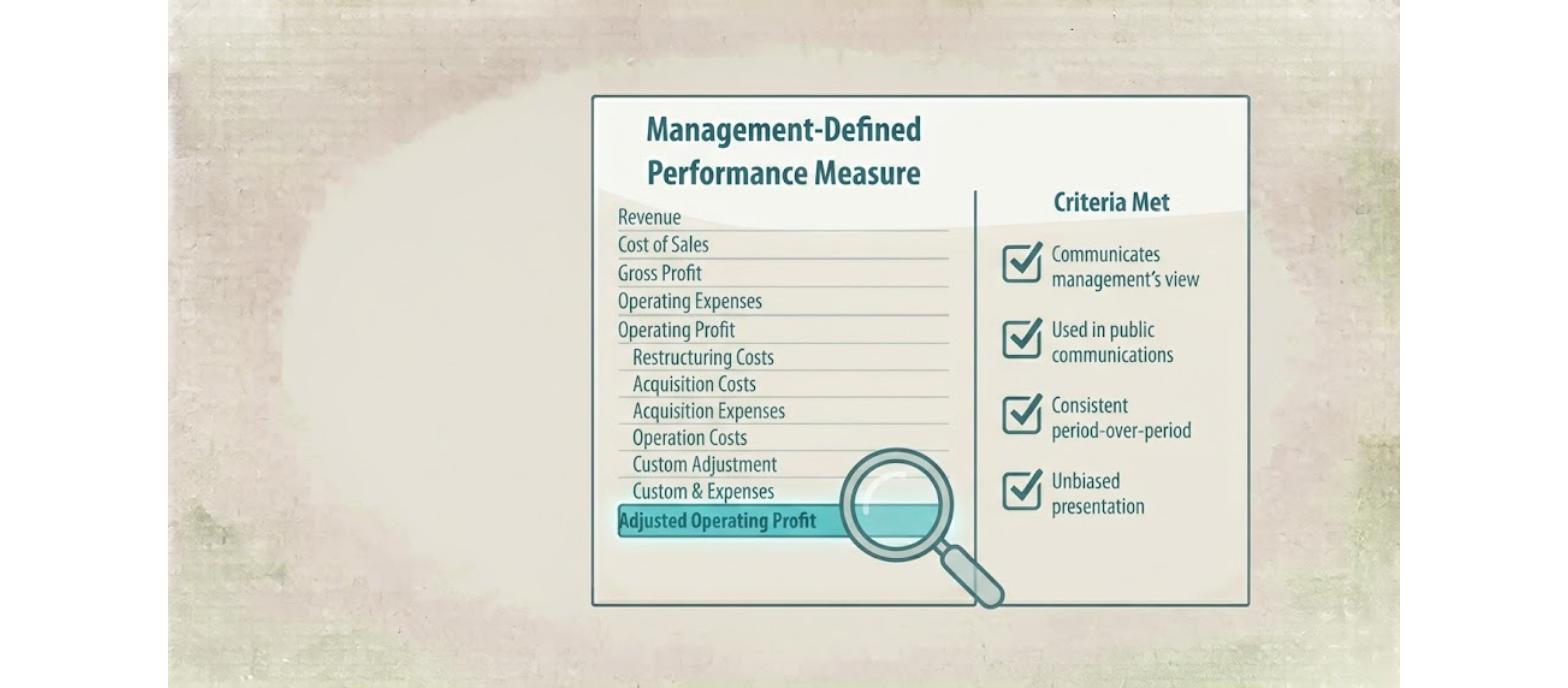
A management-defined performance measure (MPM) is a subtotal of income and expenses that a company uses in public communications outside its financial statements — earnings releases, investor presentations, management commentary — to communicate management’s view of an aspect of the entity’s financial performance, and that is not a subtotal specifically required or defined by IFRS Accounting Standards. Familiar examples include “adjusted EBITDA”, “underlying profit”, “core earnings”, and similar figures that strip out items management considers non-representative of ongoing performance.
Before IFRS 18, these measures existed entirely outside the audited financial statements, subject only to whatever regulatory non-GAAP guidance applied in a given jurisdiction. IFRS 18 changes that by pulling a defined subset of them directly into the notes to the financial statements — meaning they become subject to audit for the first time.
What Qualifies as an MPM — And What Does Not
Three conditions must all be met for a measure to be an MPM under IFRS 18:
- It is a subtotal of income and expenses (not, for example, a balance sheet ratio, a non-financial KPI, or a cash flow measure).
- It is used in public communication outside the financial statements — a figure calculated only for internal management reporting and never communicated publicly is not an MPM.
- It communicates management’s view of financial performance, and is not one of the totals or subtotals specifically required by IFRS Accounting Standards (so operating profit itself, or profit before tax, are never MPMs — they are already IFRS-defined).
Measures that are explicitly excluded from the MPM definition include segment information already required by IFRS 8, and non-GAAP measures that are not subtotals of income and expenses at all (such as free cash flow, which is a cash flow measure, or return on capital employed, which is a ratio).
The New Mandatory MPM Note
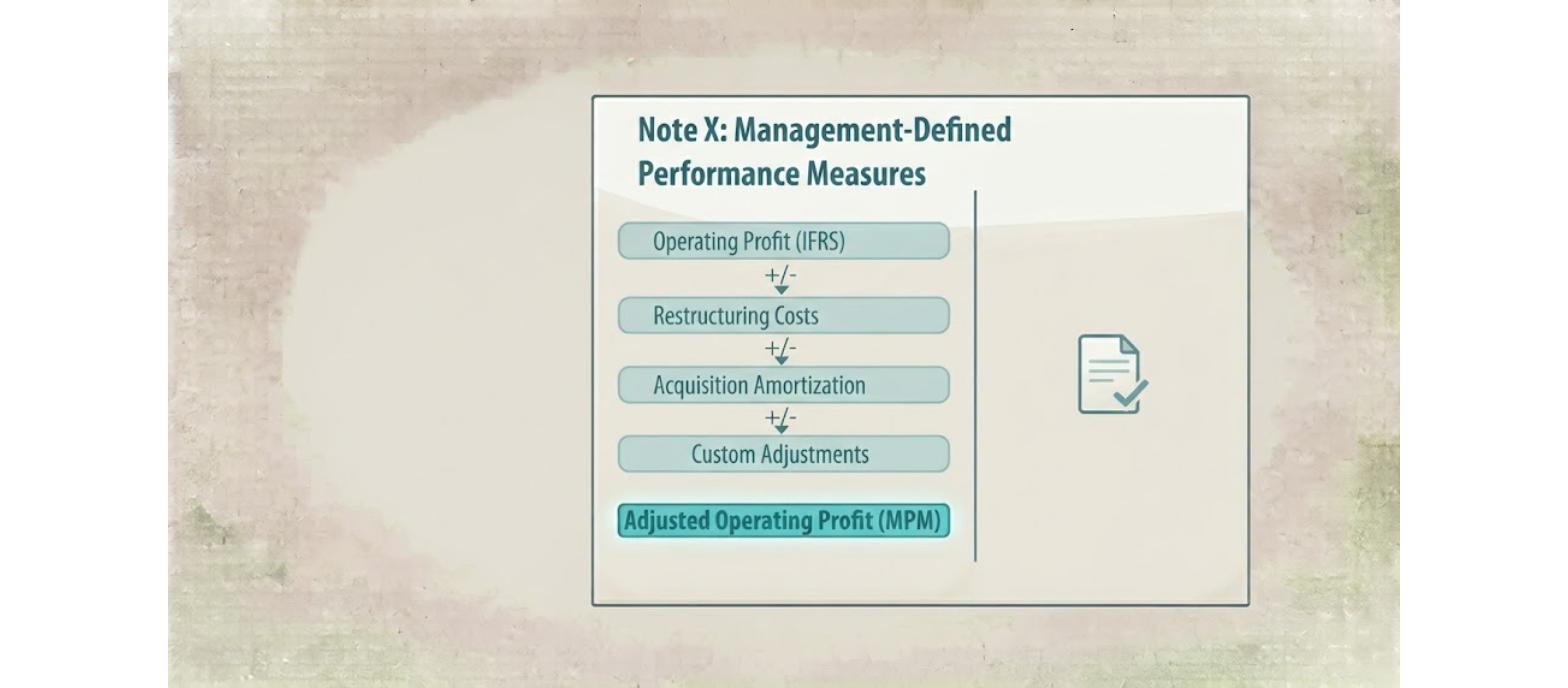
For every measure that meets the MPM definition, IFRS 18 requires a single note (or a clearly cross-referenced set of notes) disclosing, at minimum:
- A description of why the measure provides useful information about the entity’s financial performance, and how it is calculated.
- A reconciliation between the MPM and the most directly comparable IFRS-specified subtotal, showing each reconciling item separately.
- The income tax effect and the effect on non-controlling interests of each individual reconciling item.
- If the measure or its calculation changes from the prior period, an explanation of the change and the reason for it.
Because this note is now part of the audited financial statements, external auditors must obtain sufficient appropriate audit evidence over the MPM reconciliation — a materially different level of scrutiny than adjusted-profit figures typically received when they lived only in an earnings press release.
Why This Matters for Management Commentary
Many companies will need to decide, ahead of 2027, whether to keep publishing their existing “adjusted profit” style measures (now subject to the full MPM note, reconciliation, and audit) or to retire them in favour of the IFRS-specified subtotals introduced in Part 3 of this series. Retiring a long-used measure can affect comparability with prior years and analyst models, while keeping it now comes with meaningfully higher disclosure and audit cost — this is a genuine strategic decision for finance and investor relations teams, not a compliance afterthought.
Worked Example: A Simple MPM Reconciliation
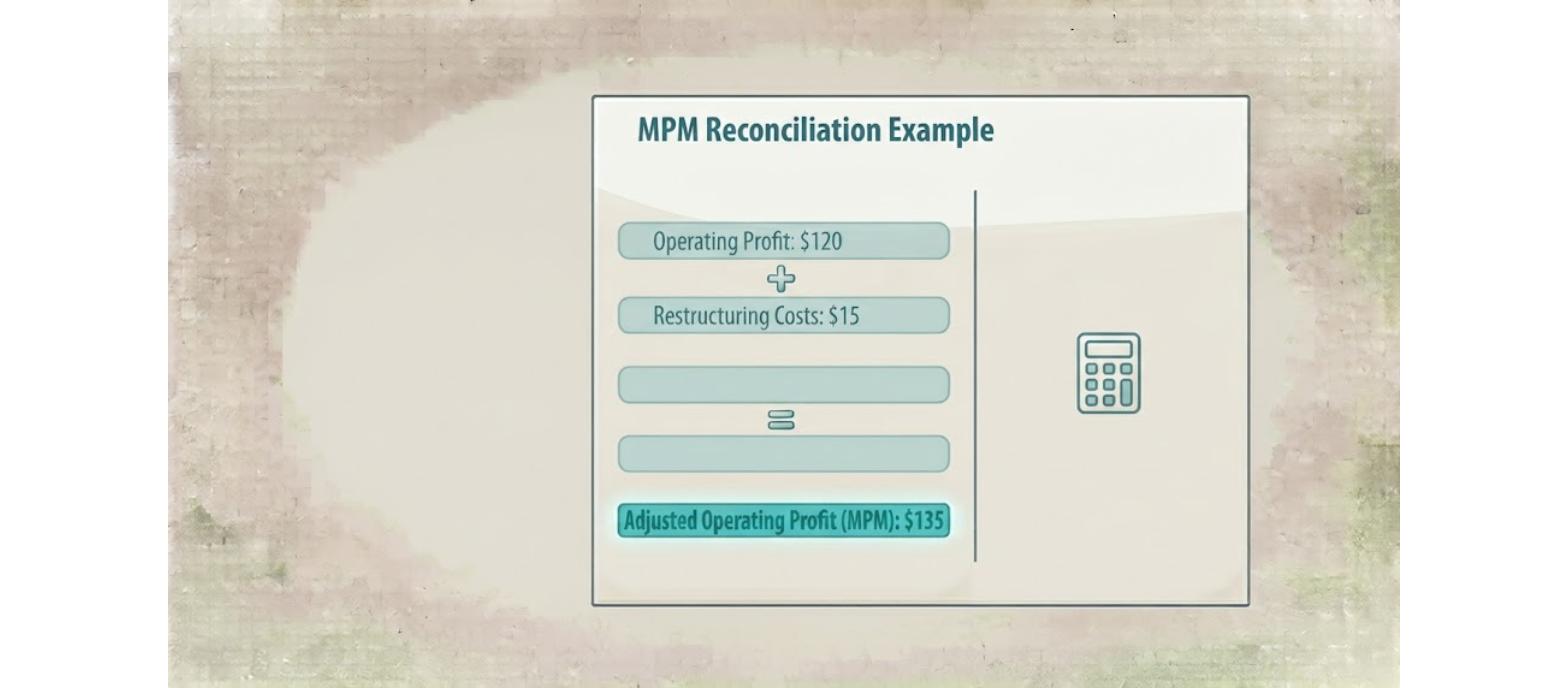
Suppose a company continues to publish “Adjusted operating profit” as an MPM, excluding a one-off restructuring charge and an acquisition-related intangible amortisation charge from its IFRS 18 operating profit of 115:
- Operating profit (IFRS 18 subtotal) = 115
- Add back: restructuring charge = 9
- Add back: acquisition-related intangible amortisation = 6
- Adjusted operating profit (MPM) = 130
- Tax effect of reconciling items disclosed separately: restructuring charge tax effect (2); amortisation tax effect (1)
Under IFRS 18, this entire reconciliation — including the two tax-effect lines — must now appear in the audited notes, not just in an investor slide deck.
Common Misconceptions About MPMs
- Assuming all non-GAAP measures are MPMs. Only subtotals of income and expenses used in public communication qualify — cash flow measures and ratios like free cash flow or ROCE are excluded.
- Thinking internal-only management figures are caught. A measure never communicated publicly outside the financial statements is not an MPM.
- Underestimating audit implications. Once a measure sits in the MPM note, auditors must obtain evidence over its reconciliation — this can require new controls and documentation that did not previously exist for these figures.
- Forgetting the tax and non-controlling-interest disclosure. The reconciliation must show the tax and NCI effect of each individual reconciling item, not just the pre-tax adjustment.
Decide Your MPM Strategy Before 2027
Whether to keep, redesign, or retire your adjusted performance measures is a decision best made well ahead of first-time adoption. SABIO Consultancy can help assess the audit and disclosure impact of your current non-GAAP measures. Talk to our IFRS specialists →