
IFRS & IAS 🌐 Global IFRS
IFRS 18 Fundamentals & Overview: What Replaces IAS 1 in 2027
Part 1 of an 8-part series on IFRS 18 Presentation and Disclosure in Financial Statements — what it is, why it replaces IAS 1, and the key changes every IFRS preparer needs to plan for.
Quick Summary
- IFRS 18 Presentation and Disclosure in Financial Statements was issued by the IASB in April 2024 and replaces IAS 1, effective for annual periods beginning on or after 1 January 2027 (early adoption permitted).
- It does not change how profit or loss is measured — only how income and expenses are classified, structured, and disclosed.
- Every item of income and expense must now be classified into one of five categories: operating, investing, financing, income taxes, and discontinued operations.
- Two new mandatory subtotals are introduced: operating profit or loss, and profit or loss before financing and income taxes.
- A new note requires disclosure and reconciliation of management-defined performance measures (MPMs) — the adjusted profit figures companies publish outside the financial statements.
- Consequential amendments to IAS 7 change how the cash flow statement is prepared, including the required starting point for the indirect method.
- IFRS 18 applies to all entities preparing IFRS financial statements, not just listed companies.
IFRS 18 Presentation & Disclosure Series — Part 1 of 8
Part 1: Fundamentals & Overview | Part 2: The Three P&L Categories | Part 3: New Required Subtotals | Part 4: Expenses by Nature vs Function | Part 5: Management-Defined Performance Measures | Part 6: Aggregation & Disaggregation | Part 7: Cash Flow Statement Changes | Part 8: Transition & First-Time Adoption

What Is IFRS 18 and Why Was It Issued?
IFRS 18 Presentation and Disclosure in Financial Statements is a new accounting standard issued by the International Accounting Standards Board (IASB) in April 2024. It replaces IAS 1 Presentation of Financial Statements, which had governed how companies structure and present their financial statements since 2007. IFRS 18 is one of the most significant changes to financial statement presentation in almost two decades, and it will affect every company that prepares financial statements under IFRS Accounting Standards — not just large listed groups.
Importantly, IFRS 18 does not change how profit or loss is measured. Revenue recognition, expense recognition, and the recognition and measurement requirements of other standards (IFRS 15, IFRS 9, IFRS 16, and so on) are untouched. What changes is how income and expenses are classified, structured, and disclosed in the primary financial statements and notes — principally the statement of profit or loss (income statement).
The Problem IFRS 18 Solves
Under IAS 1, companies had wide discretion over how they structured their income statements. Some presented an “operating profit” subtotal; others did not. Some grouped items by function, others by nature, and some mixed both approaches inconsistently between periods. Investors and analysts repeatedly told the IASB that this flexibility made it difficult to compare profitability between companies, and even between the reported IFRS figures and the “adjusted” or “underlying” profit measures companies published separately in earnings releases and investor presentations. IFRS 18 responds directly to this feedback with three connected reforms: a defined structure for the income statement, two new mandatory subtotals, and a formal disclosure regime for the non-IFRS performance measures management chooses to publish.
IFRS 18 vs IAS 1: What Actually Changes
What Stays the Same
- The statement of financial position (balance sheet) and statement of changes in equity are unaffected in structure.
- Core presentation concepts carried over from IAS 1: fair presentation, the going concern basis, accrual accounting, materiality, and consistency of presentation.
- General requirements for comparative information and the frequency of reporting are unchanged.
- Recognition and measurement of income, expenses, assets, and liabilities remain governed by their respective standards (IFRS 9, IFRS 15, IFRS 16, IAS 12, etc.) — IFRS 18 does not touch these.
What Is New
- A mandatory structure for the statement of profit or loss, built around defined categories for classifying income and expenses.
- Two new required subtotals: operating profit or loss and profit or loss before financing and income taxes.
- A new note requiring disclosure and reconciliation of management-defined performance measures (MPMs) — the “adjusted profit” style figures companies publish outside the financial statements.
- Enhanced, more prescriptive principles for when items should be aggregated versus disaggregated on the face of the statements and in the notes, including tighter rules on the use of vague labels such as “other”.
- Consequential amendments to IAS 7 Statement of Cash Flows, including a single mandatory starting point for the indirect-method reconciliation and removal of the free choice for classifying interest and dividend cash flows.
The Three New Mandatory Categories at a Glance
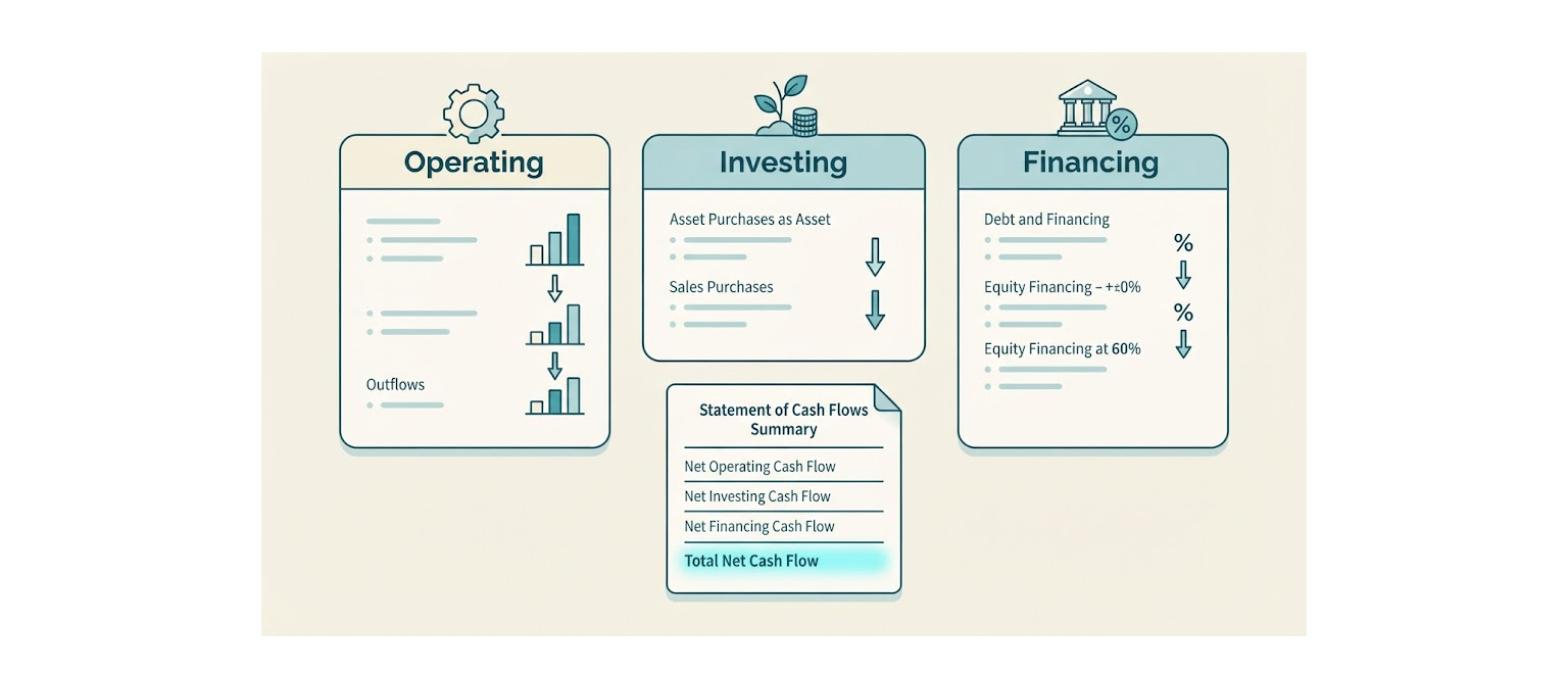
The centrepiece of IFRS 18 is a requirement to classify every item of income and expense recognised in the statement of profit or loss into one of five categories: operating, investing, financing, income taxes, and discontinued operations. The income tax and discontinued operations categories are largely carried forward from existing practice, so the real behavioural change for most companies sits in the first three:
- Operating category — the default category. It captures income and expenses from an entity main revenue-generating activities, plus anything that does not clearly belong in the investing or financing categories. For most businesses this is where the bulk of the income statement will sit.
- Investing category — income and expenses from investments in associates, joint ventures, and other assets that generate returns largely independent of an entity other resources (for example dividend income, gains or losses on disposal of investments, and returns from investment property).
- Financing category — income and expenses from transactions that raise finance (and their subsequent unwinding), including interest expense on borrowings and lease liabilities, and — with limited exceptions — interest income.
We cover the classification rules for each category — including the specific exceptions for entities whose main business is investing or providing financing — in full depth in Part 2 of this series.
Two New Required Subtotals
Because every income and expense item is now classified into one of the categories above, IFRS 18 is able to mandate two subtotals that IAS 1 never formally required:
- Operating profit or loss — the total of all items classified in the operating category. This is the first standardised “operating profit” line IFRS has ever required, and it should make like-for-like comparison between companies far more reliable.
- Profit or loss before financing and income taxes — operating profit plus the investing category, before financing income and expenses and tax. This subtotal is particularly useful for analysts building enterprise-value-based valuation models.
We walk through exactly how these subtotals are built, with a worked income statement, in Part 3.

Management-Defined Performance Measures — A New Disclosure
Many companies publish “adjusted” or “underlying” profit figures in press releases, investor presentations, and management commentary that are not defined by IFRS. IFRS 18 formally brings these measures — which it calls management-defined performance measures (MPMs) — inside the audited financial statements for the first time. If a subtotal of income and expenses meets the MPM definition, management must now disclose it in a single dedicated note, reconciled line-by-line to the most directly comparable IFRS-specified subtotal, together with the tax and non-controlling-interest effect of each reconciling item and an explanation of why the measure provides useful information. This is intended to bring the same rigour and auditability to “adjusted profit” figures that already applies to statutory IFRS numbers. Part 5 of this series is dedicated entirely to MPMs, including which measures are — and are not — caught by the definition.
Other Notable Changes: Aggregation, Disaggregation & Cash Flow
Two further changes round out the standard. First, IFRS 18 introduces a clearer, more prescriptive principle for deciding when similar items should be grouped together (aggregated) versus shown separately (disaggregated), and it restricts the use of catch-all labels like “other” — an item labelled “other” that is individually material, or a group of “other” items that is collectively material, must now be described more specifically. Second, IFRS 18 makes consequential amendments to IAS 7: the indirect-method cash flow reconciliation must now start from the new operating profit subtotal (rather than from a company-chosen starting point), and the previous free choice in classifying interest paid, interest received, and dividends received or paid as operating, investing, or financing activities is removed — these cash flows now follow the classification of the related item in the statement of profit or loss. We cover aggregation and disaggregation in Part 6 and the cash flow statement changes in Part 7.
Effective Date and Transition
IFRS 18 is effective for annual reporting periods beginning on or after 1 January 2027, with earlier application permitted (subject to disclosure of that fact). It must be applied retrospectively, and in the year of initial application entities are required to provide specific transition disclosures reconciling each line item and subtotal previously presented under IAS 1 to its new IFRS 18 classification. Given the amount of process, chart-of-accounts, and reporting-system redesign this involves, the IASB and most professional bodies are encouraging companies to begin transition planning well before the effective date rather than treating 2027 as the starting point. Part 8 of this series is a dedicated transition and first-time adoption playbook.
Who Does IFRS 18 Apply To?
IFRS 18 applies to every entity that prepares general purpose financial statements under IFRS Accounting Standards — it is not limited to listed companies. Private companies, subsidiaries preparing IFRS-based reporting packages for group consolidation, and first-time IFRS adopters are all in scope, since IFRS 18 replaces IAS 1 in its entirety rather than adding an optional layer on top of it. Groups that report under IFRS for consolidation purposes even though their local statutory accounts follow a different framework (such as local GAAP) will also need to update their group reporting templates and chart-of-accounts mapping ahead of the 2027 effective date.
Common Misconceptions About IFRS 18
- IFRS 18 only affects listed companies. It replaces IAS 1 for every IFRS preparer, including private companies and subsidiaries reporting into an IFRS group package.
- Our reported profit figure will change. IFRS 18 changes presentation and disclosure, not recognition or measurement — the bottom-line profit or loss figure itself does not change because of this standard.
- We need to comply immediately. The mandatory effective date is annual periods beginning on or after 1 January 2027; early adoption is optional, not required.
- MPM disclosure is the same as existing non-GAAP guidance. IFRS 18 introduces a new, IFRS-specific, audited MPM disclosure with its own definition and reconciliation requirements — it is not simply a restatement of existing regulatory non-GAAP rules.
- This is just a cosmetic relabeling exercise. Classifying every income and expense item into the new categories typically requires chart-of-accounts changes, updated consolidation templates, and revised management reporting — it is a genuine systems and process project, not a one-off disclosure tweak.
Start Your IFRS 18 Transition Assessment Early
With the 1 January 2027 effective date approaching, the earlier your finance team maps its chart of accounts to the new categories, the smoother the transition. SABIO Consultancy can help you assess the impact on your income statement, cash flow statement, and management reporting. Talk to our IFRS specialists →