
IFRS 15 Revenue Recognition Five Step Model
A technical guide to applying the IFRS 15 five-step model correctly — from identifying a valid contract through recognizing revenue as performance obligations are satisfied.
Quick Summary
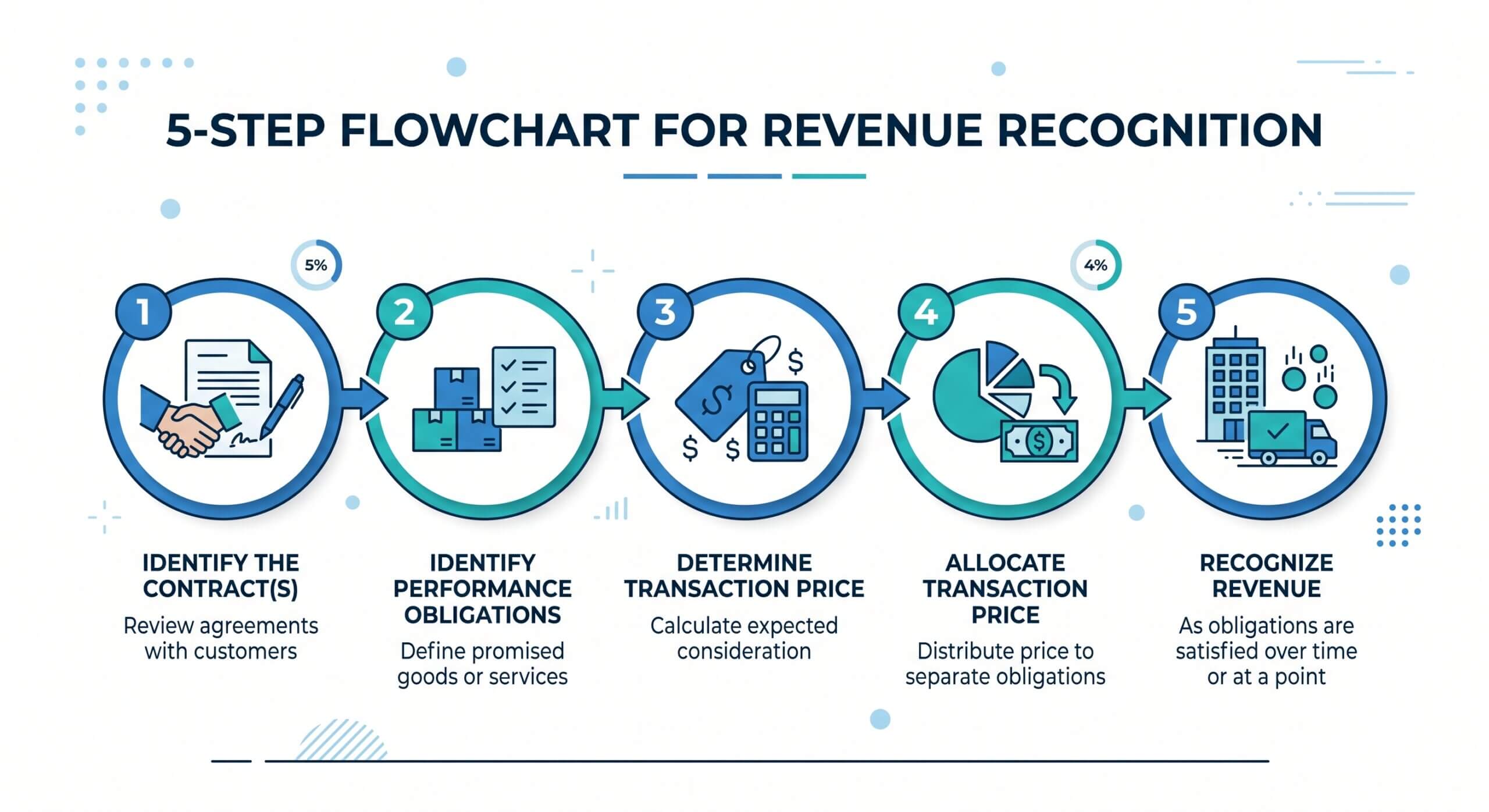
- Step 1: Identifying the Contract — the five criteria a contract with a customer must meet before any revenue can be recognized under IFRS 15.
- Step 2: Identifying Performance Obligations — separating a contract into each distinct promise of goods or services, including bundled arrangements.
- Step 3: Determining Transaction Price — the total consideration a company expects to receive, adjusted for variable consideration, financing, and non-cash elements.
- Step 4: Allocating the Price — splitting the transaction price across performance obligations based on their relative standalone selling prices.
- Step 5: Recognizing Revenue — recording revenue as each performance obligation is satisfied, either over time or at a single point in time.

Part 1: Fundamentals & the Five-Step Model · Part 2: Worked Examples · Part 3: Variable Consideration · Part 4: Contract Modifications · Part 5: Principal vs. Agent · Part 6: Licensing & Royalties
Scope & Objective
IFRS 15, Revenue from Contracts with Customers, replaced the previous patchwork of industry-specific revenue guidance with a single, principle-based framework. Its core principle is straightforward to state and demanding to apply correctly:
- The core principle: a company recognizes revenue to depict the transfer of promised goods or services to customers in an amount that reflects the consideration to which the company expects to be entitled in exchange for those goods or services.
- Applied through a single 5-step model that every contract with a customer must be run through, regardless of industry — from a simple retail sale to a multi-year, multi-element software and services arrangement.
- Judgment-heavy in practice. The standard’s principles are simple to state but require real judgment at each step — particularly in identifying distinct performance obligations and estimating variable consideration — which is exactly where most restatements and audit findings originate.
- Applies to contracts with customers specifically; it does not apply to leases (IFRS 16), insurance contracts, financial instruments, or non-monetary exchanges between entities in the same line of business to facilitate sales to third parties.
Who this guide is for: finance teams and controllers preparing IFRS-based financial statements who need a structured, auditable process for revenue recognition, and anyone reviewing a company’s existing revenue policies to confirm they hold up under each of the standard’s five steps rather than just producing a plausible-looking number.
Step 1: Identifying the Contract
Before any revenue can be recognized, the arrangement must first qualify as a contract under IFRS 15. A contract exists only when all five of the following criteria are met:
- Approval and commitment. The parties have approved the contract (in writing, orally, or per customary business practice) and are committed to performing their respective obligations.
- Identifiable rights. Each party’s rights regarding the goods or services to be transferred can be identified.
- Identifiable payment terms. The payment terms for the goods or services can be identified.
- Commercial substance. The contract has commercial substance — the company’s future cash flows are expected to change as a result of the contract.
- Collectibility is probable. It is probable the company will collect the consideration to which it will be entitled, considering only the customer’s ability and intention to pay.
Why this matters: if any one of these five criteria is not met, the arrangement does not qualify as a contract under IFRS 15, and any consideration received should generally be recognized as a liability rather than revenue, until the criteria are subsequently met or specific exceptions in the standard apply. A common practical failure point is the collectibility criterion — assessing it optimistically rather than against the customer’s actual demonstrated ability to pay is one of the most frequent sources of premature revenue recognition.
Two additional situations are addressed explicitly by the standard: contract modifications (a change in scope or price is accounted for as a separate contract only if it adds distinct goods or services priced at their standalone selling price; otherwise it is accounted for prospectively or as if terminating the old contract and creating a new one) and contract combination (two or more contracts entered into at or near the same time with the same customer are combined and accounted for as a single contract when they meet specific criteria, such as being negotiated as a package with a single commercial objective).
Step 2: Identifying Performance Obligations
Once a contract is confirmed, it must be broken down into its individual performance obligations — each distinct promise to transfer a good or service to the customer. This step is where bundled arrangements are unpacked into their component parts.
A good or service is a Distinct Performance Obligation when both of the following are true: (1) the customer can benefit from the good or service either on its own or together with other readily available resources, and (2) the promise to transfer the good or service is separately identifiable from other promises in the contract. When a good or service does not meet both conditions, it is combined with other promised goods or services until a distinct bundle is identified — for example, a highly customized installation service that significantly modifies a delivered product is typically not distinct from that product and is accounted for as a single combined performance obligation, not two separate ones.
- Series of distinct goods or services. A series of distinct goods or services that are substantially the same and have the same pattern of transfer to the customer is treated as a single performance obligation — common in subscription and usage-based service arrangements.
- Immaterial promises. Goods or services that are immaterial in the context of the contract do not need to be separately assessed as performance obligations.
- Options for additional goods or services. An option that provides a customer a material right they would not receive without entering into the contract (such as a meaningful discount on future purchases) is itself accounted for as a separate performance obligation.
Getting this step wrong — either bundling promises that are genuinely distinct, or splitting a single deliverable into artificial obligations — directly distorts every subsequent step, since Steps 4 and 5 both operate at the level of the individual performance obligation.
Step 3: Determining Transaction Price
The transaction price is the amount of consideration a company expects to be entitled to in exchange for transferring the promised goods or services, excluding amounts collected on behalf of third parties (such as sales tax). Determining it requires evaluating several adjusting factors:
- Variable consideration — discounts, rebates, refunds, credits, incentives, performance bonuses, penalties, or other contingent amounts. Estimated using either the expected value method (a probability-weighted sum, appropriate when a company has a large number of similar contracts) or the most likely amount method (appropriate when the contract has only two possible outcomes), applied consistently to similar contract types.
- The constraint on variable consideration. Variable consideration is only included in the transaction price to the extent it is highly probable that a significant reversal in the cumulative revenue recognized will not occur when the uncertainty is resolved — a deliberately conservative gate designed to prevent companies from front-loading uncertain revenue.
- Significant financing component. When the timing of payments provides the customer or the company a significant financing benefit, the transaction price is adjusted for the time value of money — effectively separating an implicit interest component from the revenue itself.
- Non-cash consideration. Measured at fair value; if fair value cannot be reasonably estimated, it is measured by reference to the standalone selling price of the goods or services promised.
- Consideration payable to the customer. Amounts paid or credited to a customer (such as coupons or slotting fees) are generally treated as a reduction of the transaction price, unless they are payment for a distinct good or service the customer provides in return.
Why this matters: an inflated or understated transaction price flows directly into every performance obligation’s allocated revenue in Step 4 — this step is where the most subjective, estimate-driven judgments in the entire model are made, and where documentation of the reasoning behind an estimate matters most for audit purposes.
Step 4: Allocating the Price
Once the total transaction price is determined, it must be allocated across each performance obligation identified in Step 2, based on their relative standalone selling prices (SSP) — the price at which a company would sell a promised good or service separately to a customer.
- Observable price is the best evidence. When a standalone selling price is directly observable (the company sells that good or service separately), that observed price is used.
- Estimation methods when SSP is not observable:
- Adjusted market assessment approach — estimating the price a customer in that market would pay, referencing competitor pricing where relevant.
- Expected cost plus a margin approach — forecasting the expected costs of satisfying the obligation and adding an appropriate margin.
- Residual approach — usable only in limited circumstances (for example, when the selling price is highly variable or uncertain), calculated as the total transaction price minus the sum of the observable standalone selling prices of the other obligations in the contract.
- Discounts and variable amounts are generally allocated proportionately across all performance obligations, unless specific criteria indicate the discount or variable amount relates only to one or more specific obligations rather than the contract as a whole.
A common source of error at this step is defaulting to the residual approach for convenience rather than confirming it genuinely qualifies under the standard’s narrow criteria — the residual approach is the exception, not the default estimation method.
Step 5: Recognizing Revenue
Revenue for each performance obligation is recognized when (or as) the company satisfies that obligation by transferring control of the promised good or service to the customer. The critical determination at this step is whether control transfers over time or at a point in time.
- Recognize over time when at least one of the following applies: the customer simultaneously receives and consumes the benefits as the company performs; the company’s performance creates or enhances an asset the customer controls as it is created; or the asset created has no alternative use to the company and the company has an enforceable right to payment for performance completed to date.
- Recognize at a point in time when none of the over-time criteria are met — typically the case for a straightforward sale of goods, where control transfers on delivery. Indicators of control transfer include the customer having legal title, physical possession, the significant risks and rewards of ownership, and having accepted the asset.
- Measuring progress for over-time recognition uses either an output method (measuring results achieved, such as units delivered or milestones reached) or an input method (measuring effort expended, such as costs incurred relative to total expected costs), selected based on which method best depicts the actual transfer of goods or services.
Why this matters: misclassifying a point-in-time obligation as an over-time one (or vice versa) is one of the most consequential IFRS 15 errors, since it changes not just the amount of revenue recognized in a given period but the entire timing pattern across the life of the contract.

Common IFRS 15 Implementation Mistakes
- Treating a bundled arrangement as a single performance obligation by default. Failing to genuinely test each promised good or service against the two-part distinct test in Step 2 tends to understate the number of performance obligations and distorts the timing of revenue recognition.
- Recognizing variable consideration before the constraint is satisfied. Including a contingent bonus or incentive in the transaction price before it is highly probable a significant reversal won’t occur is a frequent source of overstated interim revenue.
- Applying the residual allocation approach as a default rather than confirming it meets the standard’s narrow qualifying criteria, when an observable or estimable standalone selling price was actually available.
- Ignoring a significant financing component in long-term contracts with delayed or advance payment terms, which overstates or understates revenue relative to the cash actually exchanged.
- Defaulting to point-in-time recognition without testing the three over-time criteria, particularly for service, licensing, or long-term construction-type arrangements where over-time recognition is often the correct treatment.
Most IFRS 15 restatements trace back to one of these five patterns — not a misunderstanding of the standard’s core principle, but a shortcut taken at one of the five steps instead of documenting the judgment the standard actually requires. A disciplined, step-by-step application, with the reasoning behind each judgment call retained, is what keeps a company’s revenue recognition both compliant and audit-ready.
Is Your Revenue Recognition Fully IFRS 15 Compliant?
Ensure your corporate revenue reporting is fully compliant with international standards. Contact our Financial Advisory team today.