
IFRS 16 Lease Accounting and Right of Use Asset
A technical guide to applying IFRS 16 correctly — from classifying and recognizing a lease through measuring the right-of-use asset and lease liability, including the short-term and low-value exemptions.
Want to see these numbers for your own lease? Use our free IFRS 16 Lease Accounting Calculator to get the lease liability, ROU asset, full amortisation schedule and journal entries in seconds.
Quick Summary
- Single Lessee Model: IFRS 16 eliminates the old finance/operating lease distinction for lessees — almost all leases are now recognized on the balance sheet.
- Right-of-Use Asset: Lessees recognize an asset representing their right to use the underlying leased item over the lease term.
- Lease Liability: Lessees simultaneously recognize a liability for the obligation to make future lease payments, measured at present value.
- Narrow Exemptions: Short-term leases (12 months or less) and low-value asset leases may be expensed on a straight-line basis instead.
- Lessor Accounting Unchanged: Lessors continue to classify leases as either finance or operating, largely carrying forward the previous IAS 17 model.
1. Fundamentals · 2. Worked Examples · 3. Liability Remeasurement · 4. Modifications · 5. Sale-and-Leaseback · 6. Lessor Accounting

Scope & Objective
IFRS 16 Leases establishes the principles for the recognition, measurement, presentation, and disclosure of leases, with the objective of ensuring that lessees and lessors provide relevant information that faithfully represents lease transactions. Its most significant change from the previous standard, IAS 17, is the removal of the distinction between operating and finance leases for lessees — virtually every lease now creates an asset and a liability on the lessee’s balance sheet.
- Core principle: a contract is, or contains, a lease if it conveys the right to control the use of an identified asset for a period of time in exchange for consideration.
- Applies to: leases of property, plant, and equipment, including subleases, with the lessee’s right-of-use model applying to substantially all lease arrangements.
- Excluded from scope: leases to explore for or use minerals, oil, natural gas and similar non-regenerative resources; leases of biological assets within IAS 41; service concession arrangements within IFRIC 12; licenses of intellectual property granted by a lessor within IFRS 15; and rights held by a lessee under licensing agreements within IAS 38 for items such as films, patents, and copyrights.
- Practical expedients available: lessees may elect not to apply the recognition requirements to short-term leases and leases of low-value assets, instead recognizing the payments as an expense on a straight-line basis over the lease term.
- Identifying a lease: requires assessing whether the customer has the right to obtain substantially all of the economic benefits from use of an identified asset, and the right to direct how and for what purpose the asset is used throughout the period of use.
Lease Classification: The Single Lessee Model
Under IAS 17, a lessee first classified a lease as either a finance lease (on-balance-sheet) or an operating lease (off-balance-sheet, disclosed only in the notes). IFRS 16 removed that classification step for lessees entirely.
What changed:
- No more off-balance-sheet operating leases for lessees — a lease that would previously have been classified as operating (e.g., most office and retail leases) is now brought onto the balance sheet in the same way a finance lease always was.
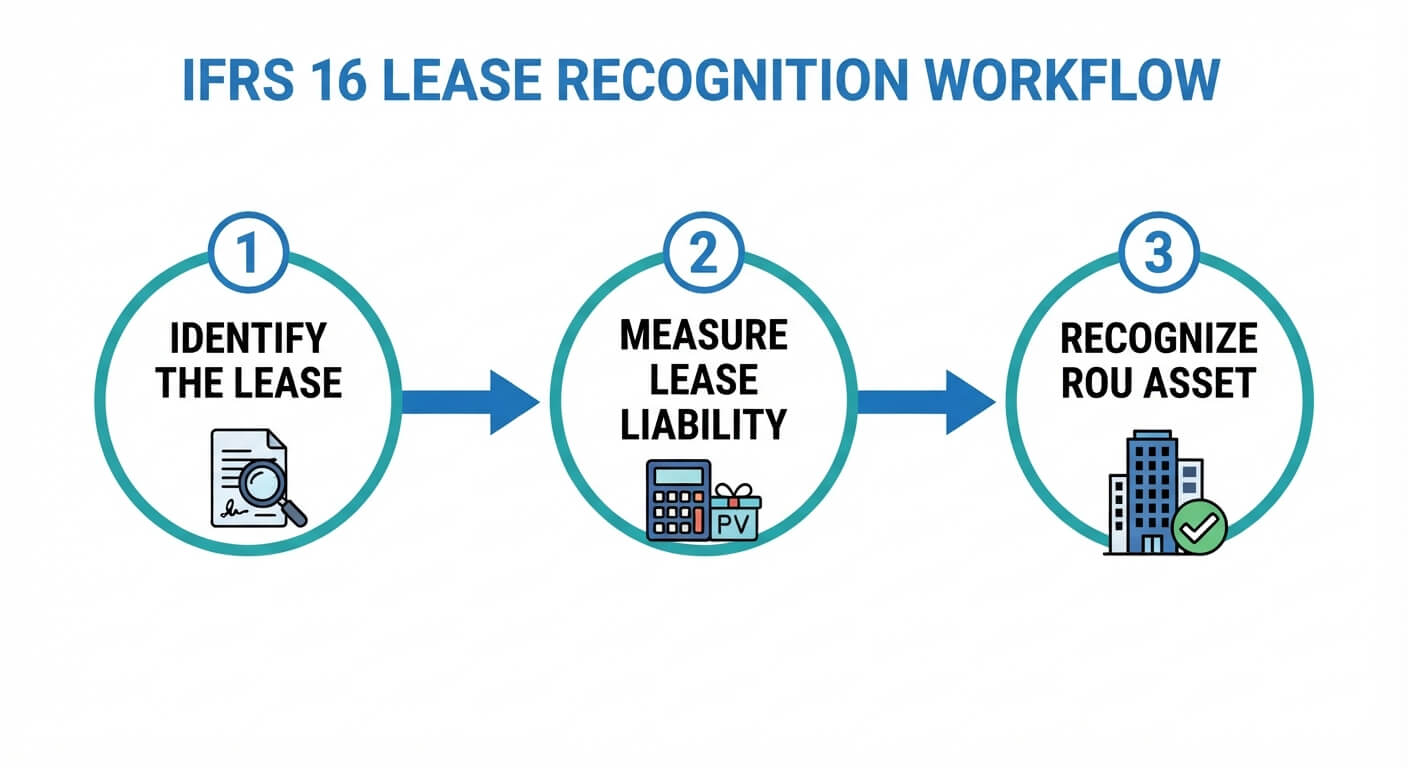
- Single recognition model: at the commencement date, a lessee recognizes a right-of-use asset and a lease liability for all leases, subject only to the short-term and low-value exemptions below.
- Comparability improved: because nearly all leases are now capitalized, IFRS 16 significantly reduces the ability of companies to structure lease arrangements specifically to keep obligations off the balance sheet.
Lessors are not affected by this change — they continue to classify each lease as either a finance lease or an operating lease, using classification criteria that are substantially carried forward from IAS 17 (see the Lessor Accounting section below).
Recognition and Measurement of the Right-of-Use Asset and Lease Liability
At the commencement date, a lessee measures the lease liability at the present value of the lease payments that are not yet paid, and measures the right-of-use asset based largely on that same liability.
Lease Liability is the present value of the lease payments not yet paid at the commencement date, discounted using the interest rate implicit in the lease or, if that rate cannot be readily determined, the lessee’s incremental borrowing rate. It represents the lessee’s obligation to make future payments over the lease term.
Right-of-Use (ROU) Asset represents a lessee’s right to use an underlying asset over the lease term. It is initially measured at cost, comprising the initial amount of the lease liability, plus any lease payments made at or before commencement, initial direct costs, and an estimate of dismantling or restoration costs, less any lease incentives received.
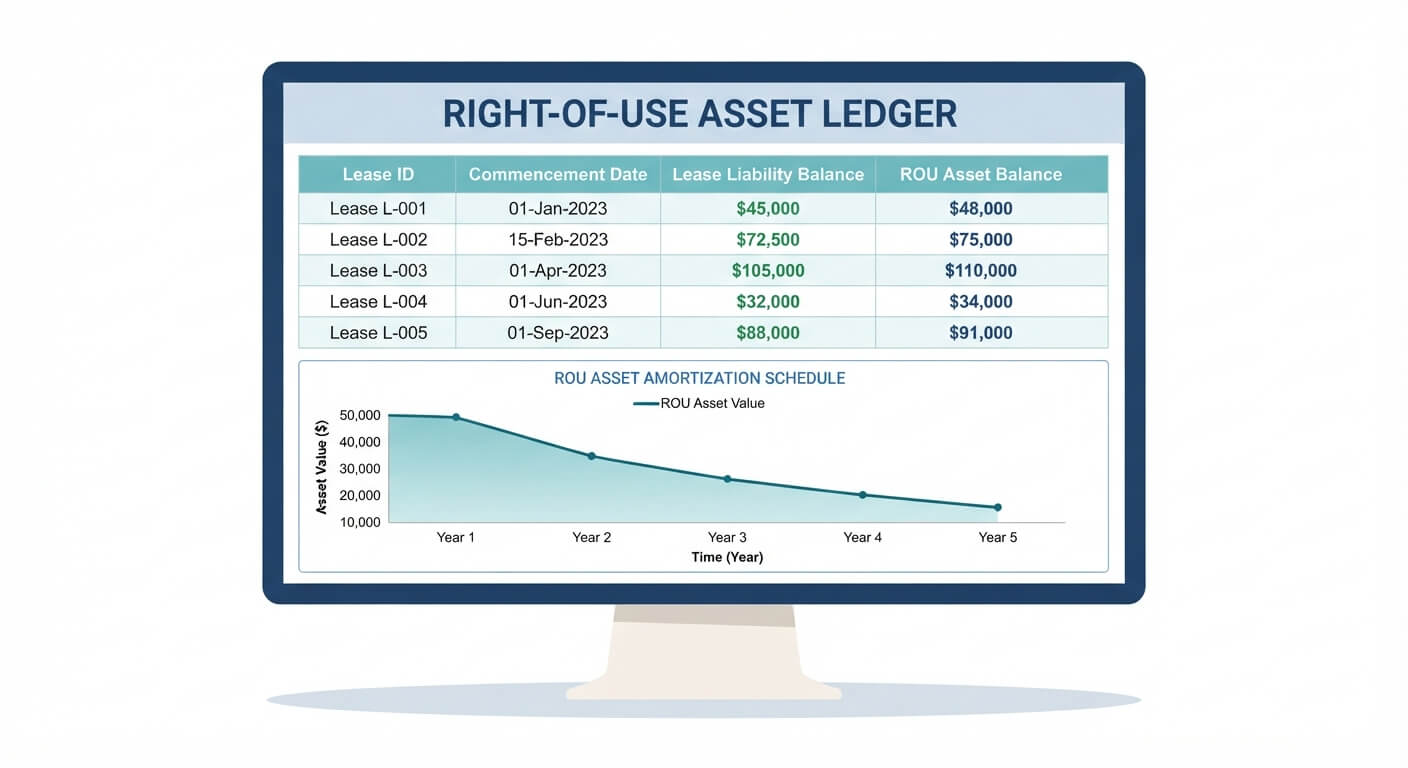
The two figures are closely linked at commencement — the ROU asset is built largely from the lease liability — but they diverge over the life of the lease because they are subsequently measured under entirely different models: the liability under an amortized-cost/effective-interest approach, and the asset typically under a cost-less-depreciation approach.
Lease payments included in the initial measurement of the liability:
- Fixed payments, less any lease incentives receivable from the lessor.
- Variable lease payments that depend on an index or a rate, initially measured using the index or rate as at the commencement date.
- Amounts expected to be payable under residual value guarantees.
- The exercise price of a purchase option, if the lessee is reasonably certain to exercise it.
- Termination penalties, if the lease term reflects the lessee exercising an option to terminate the lease.
Excluded from the initial measurement: variable lease payments that are not based on an index or rate (e.g., payments linked to sales or usage) — these are instead expensed in the period in which the triggering event or condition occurs.
Subsequent Measurement
Once the initial recognition is complete, the right-of-use asset and the lease liability are tracked separately, using two different measurement bases.
Subsequent measurement of the lease liability:
- Increase the carrying amount to reflect interest on the lease liability, using the effective interest method.
- Reduce the carrying amount to reflect lease payments made.
- Remeasure the carrying amount to reflect any reassessment or lease modifications (e.g., a change in the lease term, a change in the assessment of a purchase option, or a change in future lease payments arising from a change in an index or rate).
Subsequent measurement of the right-of-use asset:
- Cost model (default): depreciate the ROU asset, typically on a straight-line basis, from the commencement date to the earlier of the end of its useful life or the end of the lease term (unless ownership transfers or a purchase option is reasonably certain to be exercised, in which case depreciation runs to the end of the asset’s useful life).
- Test for impairment in accordance with IAS 36 Impairment of Assets — whenever indicators suggest the ROU asset’s carrying amount may exceed its recoverable amount.
- Adjust the carrying amount for any remeasurement of the lease liability (e.g., a lease modification that is not accounted for as a separate lease).
- Other measurement bases (revaluation under IAS 16, or the fair value model under IAS 40) may apply in limited circumstances — for right-of-use assets that meet the definition of investment property, or for a class of property, plant, and equipment that is otherwise revalued.
Short-Term and Low-Value Asset Exemptions
IFRS 16 provides two narrow, optional exemptions that let a lessee avoid the full recognition model and instead expense lease payments on a straight-line basis (or another systematic basis that better reflects the pattern of benefit) over the lease term.
- Short-term leases: a lease with a lease term of 12 months or less at the commencement date, and which does not contain a purchase option. This election is made by class of underlying asset.
- Low-value asset leases: leases of assets that are of low value when new (the standard’s basis for conclusions references items such as tablets, personal computers, small items of office furniture, and telephones as illustrative examples). This election can be made on a lease-by-lease basis, regardless of whether the arrangement is material to the entity as a whole.
- Both elections are optional — a lessee may choose to apply the full recognition model even to leases that would otherwise qualify for either exemption.
- A lease is not eligible for the short-term exemption if it contains an option to purchase the underlying asset that the lessee is reasonably certain to exercise, regardless of its stated term.
Lessor Accounting
IFRS 16 largely carries forward the lessor accounting model from IAS 17, so lessors continue to classify each lease at inception as either a finance lease or an operating lease.
- Finance lease: a lease that transfers substantially all the risks and rewards incidental to ownership of an underlying asset. The lessor derecognizes the underlying asset and recognizes a net investment in the lease (a receivable), recognizing finance income over the lease term based on a pattern reflecting a constant periodic rate of return.
- Operating lease: a lease that does not transfer substantially all the risks and rewards incidental to ownership. The lessor continues to recognize the underlying asset on its own balance sheet and recognizes lease income, typically on a straight-line basis, over the lease term.
- Classification indicators carried forward from IAS 17 include: the lease transfers ownership of the asset by the end of the lease term; the lessee has a purchase option it is reasonably certain to exercise; the lease term is for the major part of the asset’s remaining economic life; the present value of the lease payments amounts to substantially all of the asset’s fair value; and the asset is of such a specialized nature that only the lessee can use it without major modification.
- Sub-leases are classified by reference to the right-of-use asset arising from the head lease, not the underlying asset itself.
Common IFRS 16 Implementation Mistakes
- Applying the old operating/finance distinction to lessee accounting — this classification step no longer exists for lessees; only lessors still classify leases this way.
- Including non-index-based variable payments (e.g., sales-linked or usage-linked payments) in the initial measurement of the lease liability, when they should be expensed as incurred.
- Forgetting to reassess the discount rate when a lease is remeasured following a reassessment of the lease term or a purchase option, which can materially change both the liability and the ROU asset.
- Misapplying the low-value asset exemption to assets that are high in value but happen to be small or portable — the exemption is based on the asset’s value when new, not its physical size.
- Overlooking impairment testing on right-of-use assets under IAS 36 when indicators are present, treating them as exempt from the standard impairment framework that applies to other non-financial assets.
Is Your Lease Portfolio Fully IFRS 16 Compliant?
Need expert guidance on lease classification, right-of-use measurement, or transition to IFRS 16? Contact our Financial Advisory team today.