
Contracts change after they are signed — scope grows, prices are renegotiated. This guide walks through the three ways IFRS 15 requires a contract modification to be accounted for, and how to tell which one applies.
- The separate-contract test: distinct goods priced at standalone selling price
- Prospective treatment for distinct remaining goods/services
- Cumulative catch-up adjustment for non-distinct remaining items
- A decision table covering every modification scenario
- A worked example comparing two pricing outcomes
Part 1: Fundamentals & the Five-Step Model · Part 2: Worked Examples · Part 3: Variable Consideration · Part 4: Contract Modifications · Part 5: Principal vs. Agent · Part 6: Licensing & Royalties

What Is a Contract Modification
A contract modification is a change in the scope or price (or both) of a contract that is approved by the parties, whether in writing, orally, or implied by customary business practice. Modifications are common: a customer adds extra units, a scope of services expands, or a price is renegotiated mid-contract. IFRS 15 does not treat every modification the same way — the correct accounting depends on what is added and at what price.
Modification Treatment Decision Table
When a modification is not accounted for as a separate contract, it is accounted for by updating the original contract, using one of two methods depending on whether the remaining goods and services are distinct from those already delivered.
| Scenario | Accounting Treatment |
|---|---|
| Additional distinct goods/services priced at standalone selling price | Separate contract — no effect on the original contract’s accounting. |
| Remaining goods/services are distinct from those already transferred | Prospective treatment: termination of the old contract and creation of a new one for the remaining consideration. |
| Remaining goods/services are not distinct (part of a single performance obligation partly satisfied) | Cumulative catch-up adjustment to revenue as of the modification date. |
| Combination of distinct and non-distinct remaining items | Allocate the effects to each performance obligation type using the two methods above as applicable. |
Prospective Treatment
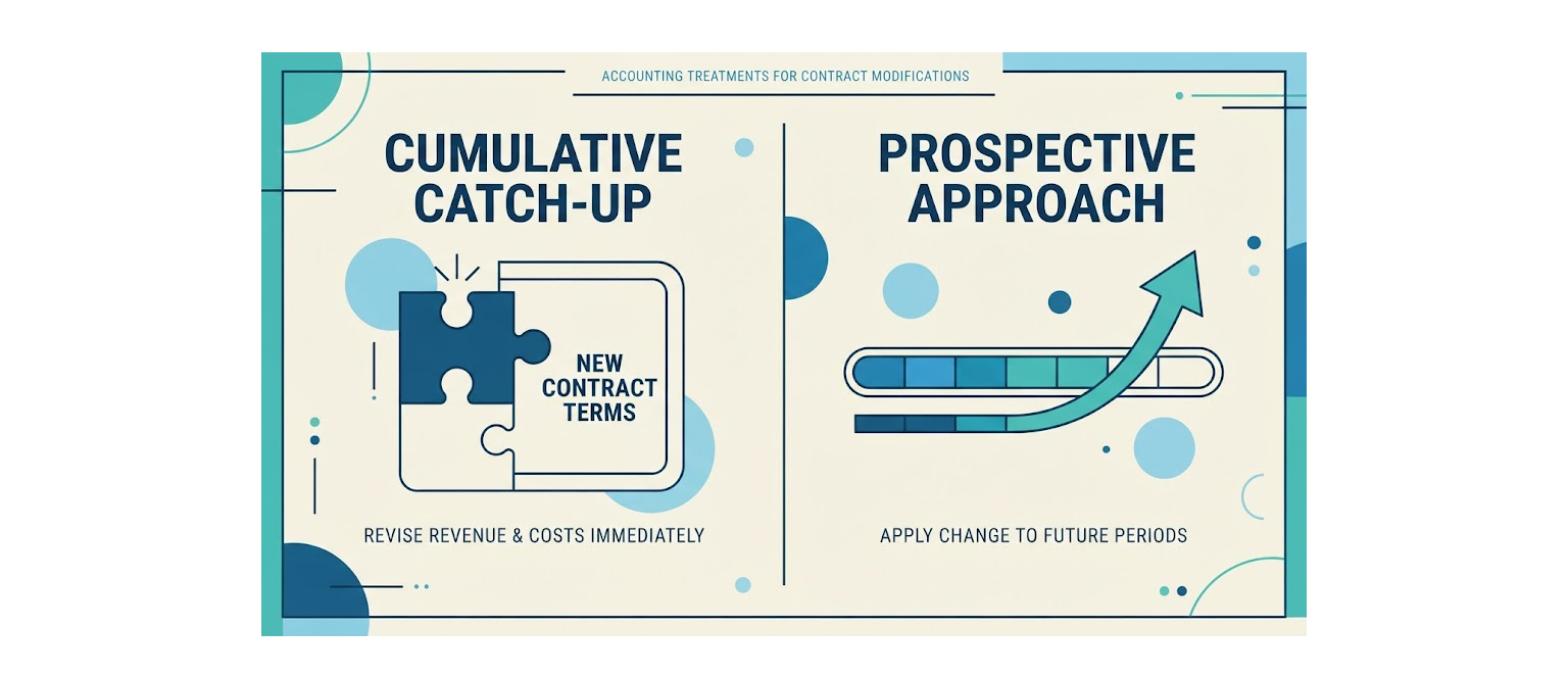
Where the remaining goods or services are distinct from those already transferred, the modification is treated as if the original contract were terminated and a new contract created. The consideration allocated to the new contract is the sum of (a) the consideration promised by the customer that has not yet been recognised as revenue, and (b) the additional consideration promised under the modification. No adjustment is made to revenue already recognised on goods or services already transferred.
Cumulative Catch-Up Adjustment
Where the remaining goods or services are not distinct — meaning they form part of a single performance obligation that is partially satisfied at the modification date — the entity updates the transaction price and the measure of progress, and recognises the cumulative effect of the change as an adjustment to revenue in the period of the modification. This is the treatment most often seen in long-term construction and engineering contracts where the scope of a single integrated project changes mid-stream.
Worked Example: Adding Goods at Standalone Price vs. Below Market
A supplier has an existing contract to deliver 100 units of equipment to a customer for $10,000 (i.e. $100/unit, which is also the standalone selling price). After delivering 60 units, the customer agrees to buy 30 more identical units.
Scenario A — priced at standalone selling price: the additional 30 units are priced at $100/unit ($3,000 total), matching the standalone selling price. Because the units are distinct and priced at standalone selling price, this is accounted for as a separate contract. The original contract’s revenue recognition is unaffected.
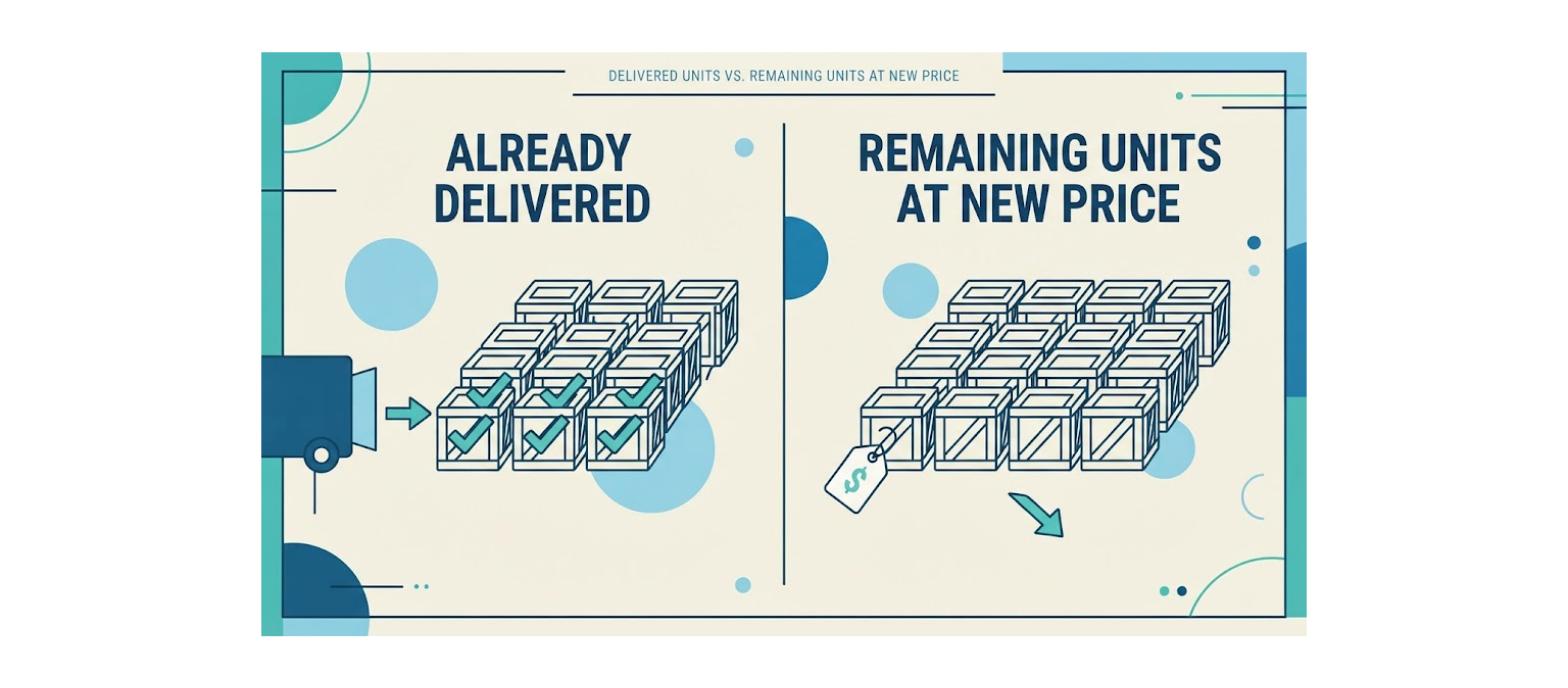
Scenario B — priced below market: the additional 30 units are instead priced at $80/unit ($2,400 total) as a loyalty discount, below the $100 standalone selling price. Because the price does not reflect standalone selling price, this is not a separate contract. Since the remaining original units and the new units are all distinct from the units already delivered, this is treated prospectively: the remaining 40 original units plus the 30 new units (70 units total) are now accounted for under a “new” contract with total remaining consideration of $4,000 (40 × $100) + $2,400 (30 × $80) = $6,400, recognised at $91.43/unit as the 70 remaining units are delivered.
Common Mistakes
- Defaulting to a cumulative catch-up adjustment for every modification, without first testing whether the remaining goods or services are actually distinct.
- Treating a price change alone as automatically qualifying for separate-contract treatment without also confirming the added goods or services are distinct.
- Forgetting that a modification can require splitting the accounting between the separate-contract method and the prospective or cumulative catch-up method when it includes a mix of distinct and non-distinct items.
- Failing to reassess the transaction price allocation across all remaining performance obligations after a prospective modification.
Renegotiating a Contract Mid-Term?
Let our team confirm your modification accounting matches IFRS 15 before you close the books.