
Cash Flow Statement Direct Method Guide
A practical, step-by-step framework for building the operating activities section of a Cash Flow Statement using the direct method — drawn straight from your Balance Sheet and Profit & Loss notes.
Quick Summary
- What Is the Direct Method — and Why Does the IASB Encourage It? — what the direct method shows, and why IAS 7 encourages it for operating activities.
- Step-by-Step: Building the Operating Activities Section from Your Balance Sheet and P&L Notes — how to derive cash received and paid figures directly from your existing records.
- Don’t Forget Investing and Financing Activities — how those sections fit alongside the operating activities you’ve just built.
- Common Pitfalls When Preparing a Direct Method Statement — the mistakes that most often trip up a Direct Method statement.
- Direct Method vs Indirect Method: Which Should You Choose? — how to decide which method is right for your business.

A clear, well-organized cash flow process starts on the desk, not just in the software.
What Is the Direct Method — and Why Does the IASB Encourage It?
The direct method reports the actual cash receipts and cash payments that occurred during the period, grouped into their major classes: cash received from customers, cash paid to suppliers, cash paid to employees, cash paid for interest, and cash paid for income tax. The result reads almost like a cash-basis income statement, which is exactly what makes it valuable to a reader trying to understand a business’s real cash-generating capacity rather than its accounting profit.
IAS 7 paragraph 19 states plainly that entities are encouraged to report cash flows from operating activities using the direct method, on the grounds that it provides information that may be useful in estimating future cash flows and that is not available under the indirect method. That is a meaningful endorsement from the standard-setter, not a passing comment: the IASB’s reasoning is that direct-method information helps users assess the amount, timing, and probability of future cash flows with more confidence than a reconciliation-style presentation can offer. In practice, most companies still choose the indirect method because it is faster to prepare from data already sitting in the general ledger. But for a board, a lender, or an investor who wants to see precisely where operating cash came from and where it went, rather than a series of adjustments to net income, the direct method is the more transparent, more decision-useful presentation.
Direct vs Indirect at a Glance
The indirect method starts with net profit and works backward, adding back non-cash charges like depreciation and reversing the effect of working-capital timing differences until it arrives at the same net operating cash figure. The direct method skips that reconciliation entirely and states the cash movements themselves. Under IAS 7, a business that chooses the direct method for its primary statement must still disclose, in the notes, a reconciliation of profit or loss to net cash from operating activities, so no information is ever lost either way. The real difference is what the primary statement communicates at a glance: cash transactions, or accounting adjustments.
Nothing in the direct method starts from net profit. Instead, each line answers a simple question: how much cash genuinely moved in or out under this heading, once every accrual, non-cash charge, and timing difference has been stripped away?
Step-by-Step: Building the Operating Activities Section from Your Balance Sheet and P&L Notes
Every direct-method line item can be built from two sources you already have on file: the current and prior period Balance Sheet, and the revenue and expense notes behind the Profit & Loss. The adjustment in each case follows the same idea applied to a different account: take the accrual-basis figure from the P&L, then correct it for the change in the related Balance Sheet balance between the two period-end dates.
Step 1 — Cash Received From Customers
Start with net revenue for the period, as reported in the P&L. Then adjust for the movement in Accounts Receivable: if trade receivables increased over the period, some of that revenue was never collected in cash, so subtract the increase; if receivables decreased, more cash came in than was billed this period, so add the decrease. The formula is: Cash Received from Customers = Revenue + Opening Accounts Receivable − Closing Accounts Receivable. Also adjust for any movement in unearned or deferred revenue on the Balance Sheet, since a deposit collected in advance is real cash even though no revenue has been recognized for it yet.

Every direct-method line traces back to a P&L note and a Balance Sheet movement.
Step 2 — Cash Paid to Suppliers and Employees
This step is built from Cost of Goods Sold and operating expenses in the P&L, corrected for three Balance Sheet accounts:
- Inventory — an increase means the business bought more stock than it expensed, so add that increase to cost of sales before adjusting for payables.
- Accounts Payable — an increase means some purchases haven’t been paid for yet, so subtract the increase, since it reduces cash actually paid; a decrease means old bills were paid down, so add it back.
- Prepaid or Accrued Expenses — an increase in prepaid expenses is a cash outflow not yet expensed; an increase in accrued expenses is an expense not yet paid in cash.
Step 3 — Cash Paid for Interest and Income Tax
Interest expense and income tax expense from the P&L rarely equal the cash actually paid in the same period, because both commonly carry an accrued or prepaid balance on the Balance Sheet. Take interest expense and adjust for the movement in Accrued Interest Payable, since an increase reduces the cash outflow when some of the expense hasn’t been paid yet; apply the same logic to income tax expense against the movement in Income Tax Payable. Some entities classify interest and tax paid within operating activities under IAS 7’s default treatment; others classify interest paid within financing and dividends received within investing. Whichever classification is used must be applied consistently period to period and disclosed.
Step 4 — Arrive at Net Cash From Operating Activities
Add the cash received from customers to any other operating cash receipts, such as royalties or fees received, then subtract cash paid to suppliers and employees, cash paid for interest, and cash paid for income tax. The result is Net Cash Generated from Operating Activities: the same total the indirect method would reach through its reconciliation, just built from actual cash movements rather than adjustments to profit.
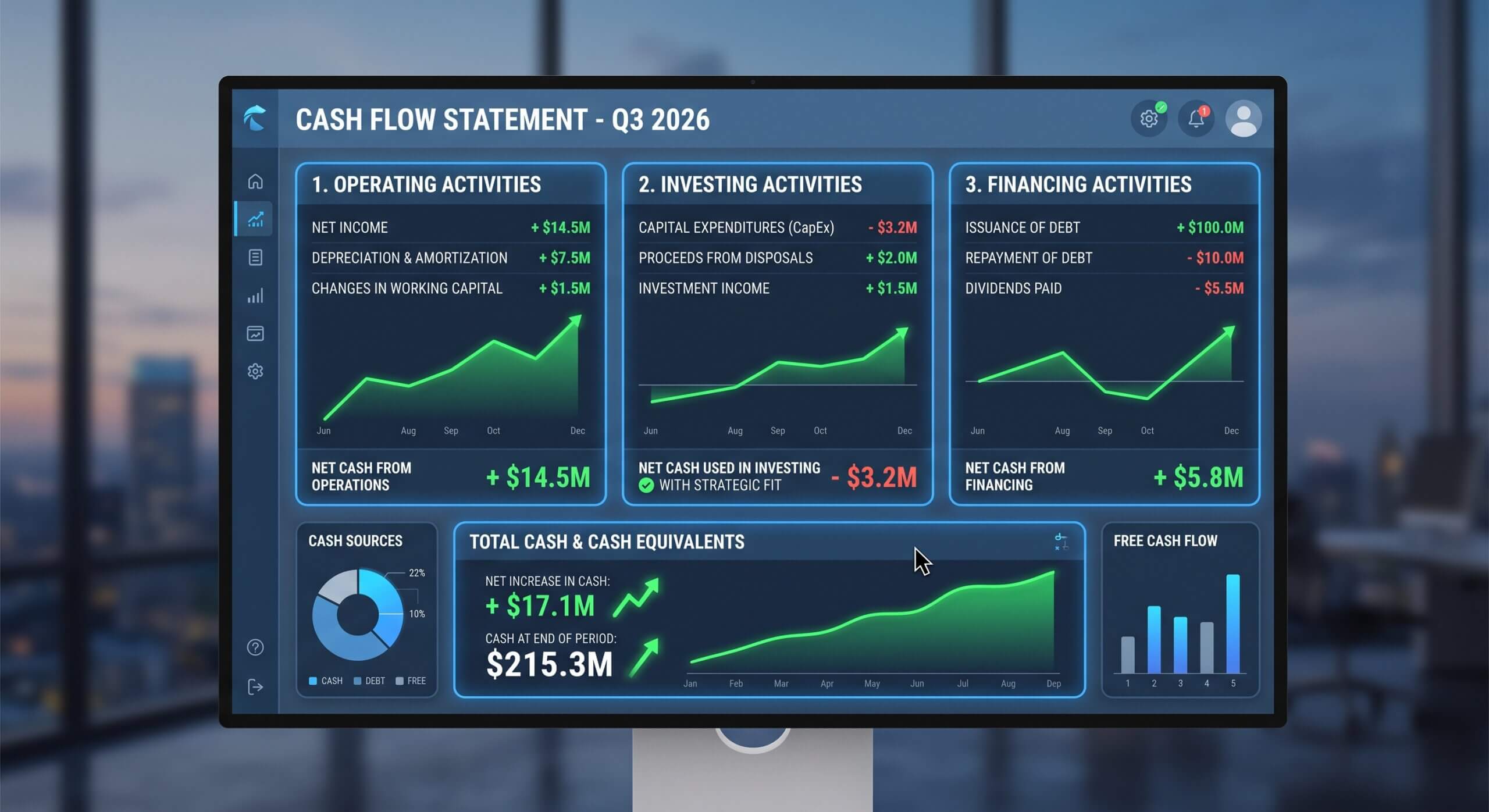
The finished statement should tie out cleanly to the closing cash balance on the Balance Sheet.
Don’t Forget Investing and Financing Activities
The direct-versus-indirect choice only affects how the operating activities section is presented; the investing and financing sections are built the same way under either method, because there was never a reconciliation-style shortcut for them in the first place. Investing activities capture cash flows from acquiring or disposing of long-term assets: purchases and sales of property, plant and equipment, and purchases and disposals of investments or intangible assets. Financing activities capture cash flows between the business and its providers of capital: proceeds from issuing shares or new borrowings, repayments of loan principal, and dividends paid to shareholders. Both sections should reconcile cleanly against the Balance Sheet’s asset, borrowing, and equity movements for the period, using the same opening-minus-closing logic applied throughout this guide.
Common Pitfalls When Preparing a Direct Method Statement
A few mistakes come up repeatedly when finance teams build their first direct-method statement:
- Reversing the direction of a working-capital adjustment. An increase in a receivable-type asset always reduces cash, and an increase in a payable-type liability always increases it; getting this backwards is the single most common error.
- Forgetting the mandatory reconciliation note. Choosing the direct method for the primary statement does not remove the requirement to disclose a reconciliation of profit or loss to net cash from operating activities in the notes.
- Missing non-cash P&L items entirely. Depreciation, amortization, and unrealized foreign exchange movements have no cash flow line under the direct method because they were never cash to begin with; they simply don’t appear, rather than needing an offsetting adjustment.
- Not tying out to the closing cash balance. The finished statement’s net increase or decrease in cash, added to the opening cash balance, must equal the actual closing cash and cash equivalents balance on the Balance Sheet; if it doesn’t, an account has been missed or misclassified somewhere in the operating, investing, or financing sections.
Direct Method vs Indirect Method: Which Should You Choose?
Strengths
Shows actual cash receipts and payments by category, gives readers a clearer view of real cash-generating capacity, and is the method explicitly encouraged by IAS 7 paragraph 19. It is also the more natural starting point for cash budgeting and forecasting conversations with lenders and investors.
Trade-offs
Requires transaction-level cash data rather than just ledger balances, so it can take more time to prepare if the accounting system isn’t already tracking cash receipts and payments by category. A supplementary profit-to-cash reconciliation note is still required regardless.
How It Works
Starts from net profit or loss and adjusts for non-cash items, such as depreciation, amortization, and provisions, plus working-capital movements, to arrive at the same net operating cash figure.
Why It’s Common
Far more businesses use the indirect method in practice because it can be built directly from the P&L and Balance Sheet without separately tracking cash transactions. The trade-off is that it shows adjustments to profit rather than actual cash movements, so a reader can’t see, at a glance, how much cash customers actually paid or how much was paid to suppliers.
It Depends on Your Audience
IAS 7 permits either method but explicitly encourages the direct method for operating activities. Investors, lenders, and boards evaluating cash-generating capacity often value the transparency of the direct method, while smaller businesses preparing statements mainly for internal or compliance purposes often default to the indirect method for speed.
Either Way, Nothing Is Lost
The reconciliation note is mandatory regardless of which method is chosen for the primary statement, so no information ever disappears, only the presentation changes. If you’re unsure which fits your reporting obligations and audience, that’s exactly the kind of judgment call worth walking through with an accountant.
Need Expert Help Preparing Accurate Financial Statements?
Need help preparing accurate financial statements for your board or investors? Our team can build, review, or clean up your Cash Flow Statement, Balance Sheet, and P&L reporting so every figure ties out.