
Accrual vs Cash Basis Accounting Worked Example: Recognition Timing, Conversion, and Mid-Year Switch
A full numeric walkthrough of accrual-versus-cash timing: the same engagement under both bases, a full cash-to-accrual net income conversion, and a mid-year method switch.
- Companion guide: a full numeric walkthrough applying the recognition timing rules explained in “Accrual vs Cash Basis Accounting for Your Business” to a real engagement, a full-year conversion, and a mid-year method switch.
- The only question that matters for every account: was cash paid or received in a different period than when the revenue was actually earned or the expense actually incurred? Answer that once per account, and the correct treatment follows automatically.
- Converting cash-basis net income to accrual-basis net income is a mechanical adjustment for the movement in Accounts Receivable, Accounts Payable, Prepaid Expenses, and Unearned Revenue — no re-posting of the underlying transactions is required.
- A mid-year switch to accrual accounting requires a one-time catch-up adjustment to opening retained earnings — running it through the current period’s income statement instead is a common and costly mistake.
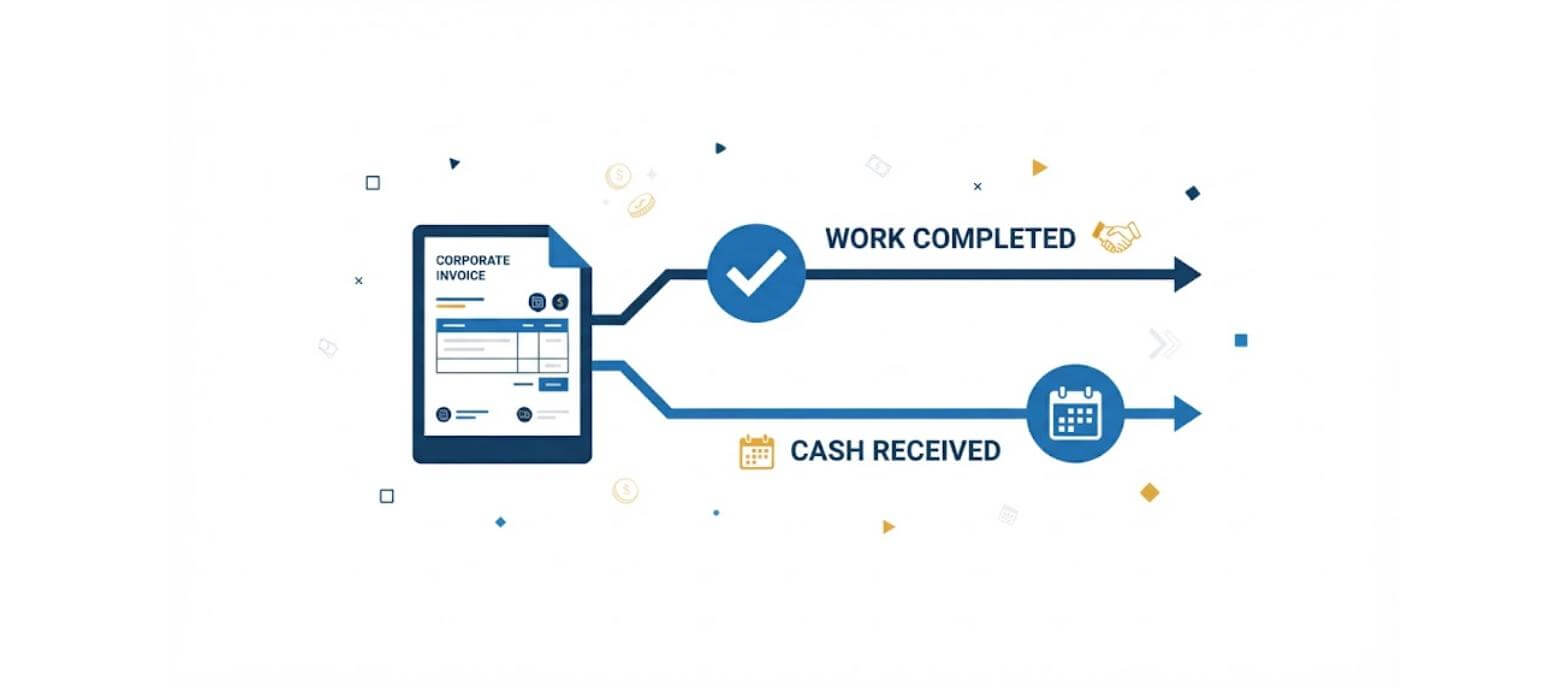
Worked Example 1: The Same Engagement Under Both Bases
A consulting firm completes a $28,000 engagement, delivering the final report and issuing the invoice on September 20 of Year 1. The client does not pay until January 12 of Year 2. The firm’s fiscal year ends December 31.
- Step 1 — Identify when the revenue is earned versus when cash changes hands: the work is completed and billed in September of Year 1; the cash is not received until January of Year 2 — a gap that straddles the fiscal year-end.
- Step 2 — Apply cash-basis accounting: Year 1’s income statement shows $0 of revenue from this engagement, since no cash was received by December 31. Year 2’s income statement shows the full $28,000 of revenue in January, when the payment lands.
- Step 3 — Apply accrual-basis accounting: Year 1’s income statement recognizes the full $28,000 of revenue in September, when the work was performed, with a $28,000 Accounts Receivable balance carried on the December 31 Year 1 balance sheet. Year 2 shows $0 of additional revenue for this engagement — the January cash receipt simply converts the receivable into cash and has no income statement impact.
- Step 4 — Compare the distortion: if this were the firm’s only engagement, cash-basis accounting would understate Year 1’s actual performance by the full $28,000 and overstate Year 2’s, while accrual-basis accounting correctly matches the revenue to the year the work was actually done.
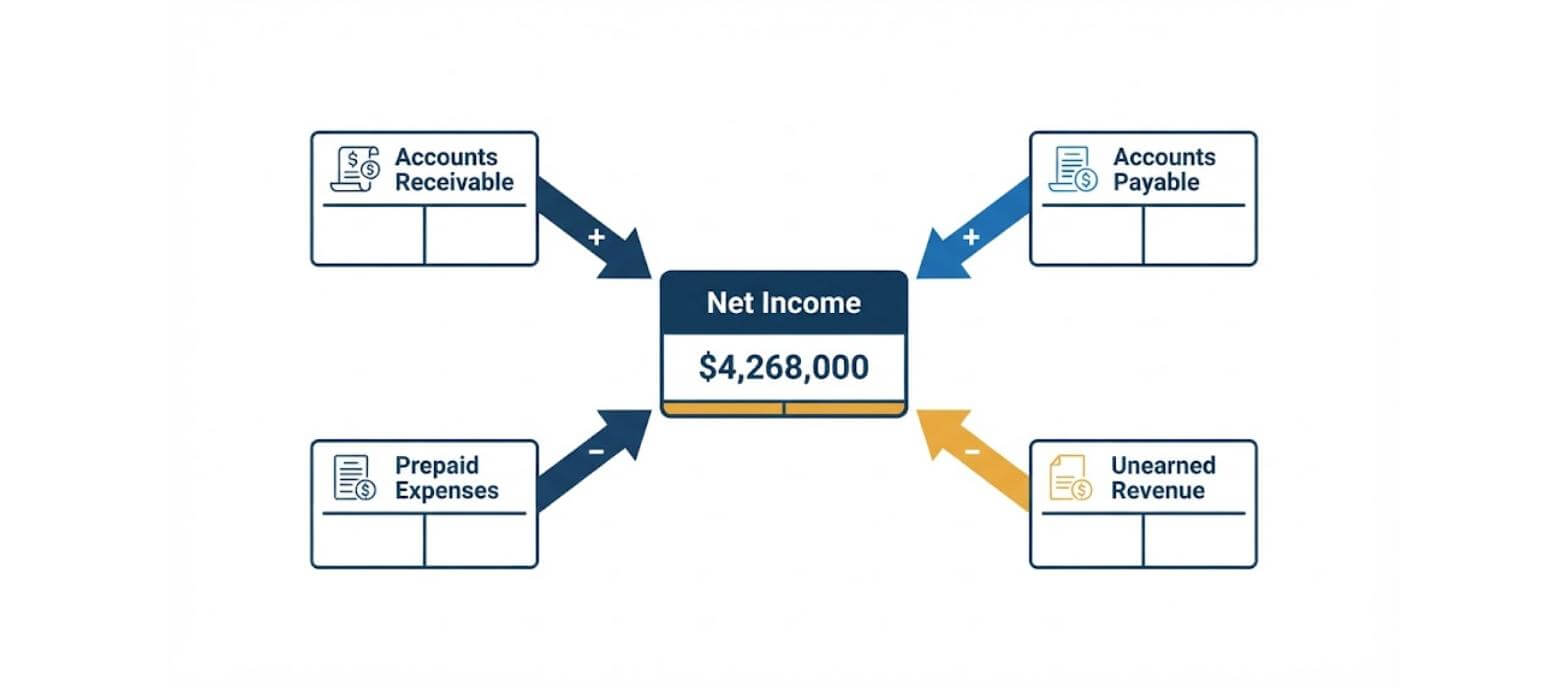
Worked Example 2: Converting Cash-Basis Net Income to Accrual-Basis Net Income
A small business reports cash-basis net income of $95,000 for the year. Accounts Receivable moved from $12,000 to $18,000, Accounts Payable moved from $9,000 to $6,000, Prepaid Insurance moved from $4,000 to $7,000, and Unearned Revenue (customer deposits for work not yet performed) moved from $5,000 to $2,000.
- Step 1 — Adjust for the change in Accounts Receivable: Closing AR − Opening AR = $18,000 − $12,000 = +$6,000. Revenue was earned but not yet collected, so it is added.
- Step 2 — Adjust for the change in Accounts Payable: −(Closing AP − Opening AP) = −($6,000 − $9,000) = +$3,000. Payables fell, meaning more cash went out paying down old bills than was incurred as new expense this period, so accrual-basis expense is lower than cash paid — net income is adjusted upward.
- Step 3 — Adjust for the change in Prepaid Insurance: Closing Prepaid − Opening Prepaid = $7,000 − $4,000 = +$3,000. More cash was paid for coverage than has actually been consumed as expense this period, so accrual-basis expense is lower — net income is adjusted upward again.
- Step 4 — Adjust for the change in Unearned Revenue: −(Closing Unearned − Opening Unearned) = −($2,000 − $5,000) = +$3,000. The deferred-revenue balance fell, meaning some previously collected cash was actually earned this period, adding to accrual-basis revenue.
- Step 5 — Total accrual-basis net income: $95,000 + $6,000 + $3,000 + $3,000 + $3,000 = $110,000.
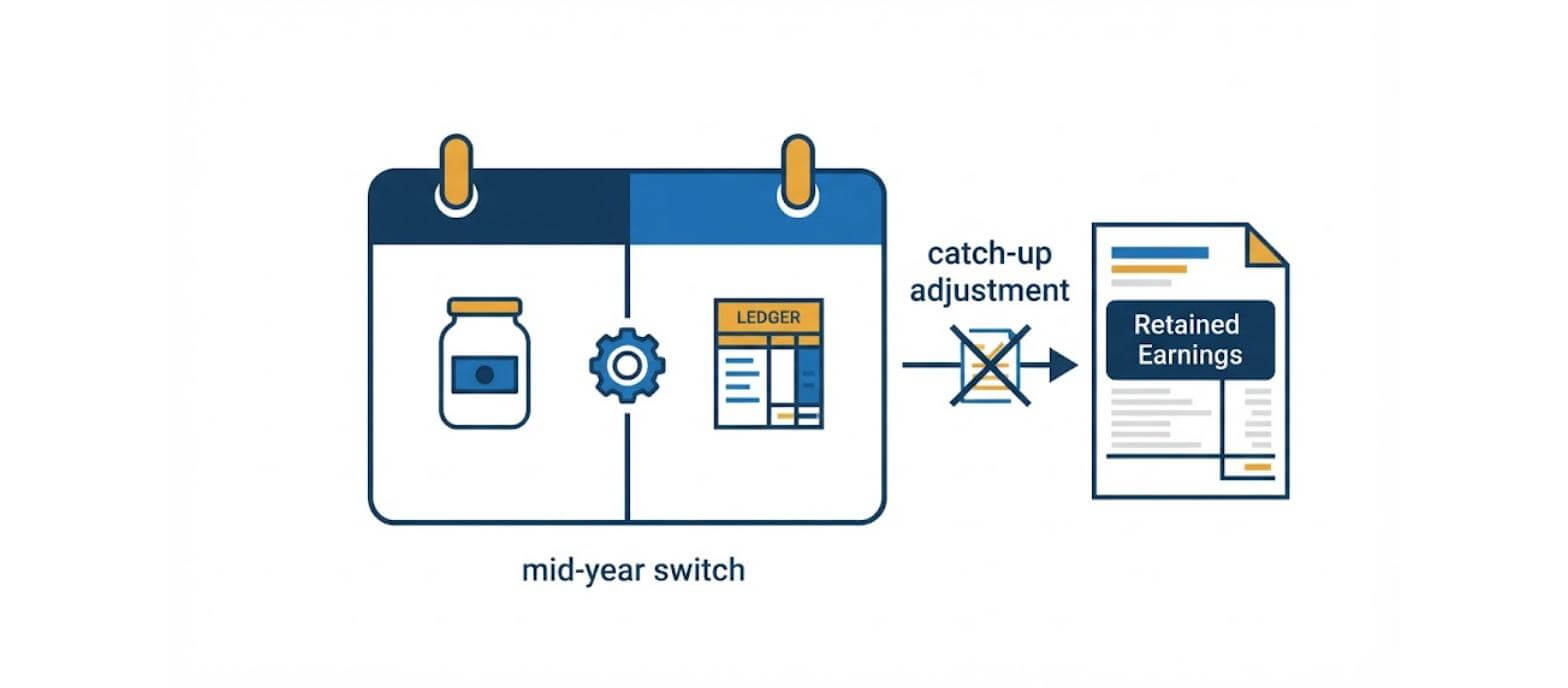
Worked Example 3: A Mid-Year Switch from Cash to Accrual
A business decides to switch from cash-basis to accrual-basis accounting effective July 1. As of that date, the following items existed but were never recorded on the cash-basis books: $22,000 of Accounts Receivable (invoices already issued for work completed before July 1, not yet collected), $14,000 of Accounts Payable (bills already received for expenses incurred before July 1, not yet paid), and $7,000 of remaining Prepaid Insurance (the unused portion of a 12-month policy paid for in February).
- Step 1 — Identify every accrual-basis asset and liability missing from the cash-basis books as of the conversion date: $22,000 Accounts Receivable, $14,000 Accounts Payable, and $7,000 Prepaid Insurance.
- Step 2 — Calculate the net catch-up adjustment: Accounts Receivable + Prepaid Insurance − Accounts Payable = $22,000 + $7,000 − $14,000 = $15,000.
- Step 3 — Post the adjustment directly to opening retained earnings, not to current-period revenue or expense: the $15,000 represents value already earned or already paid for under the old cash-basis books, not new profit generated after the switch — it is a one-time correction to the opening balance sheet.
- Step 4 — Recognize the consequence of getting this wrong: if the $15,000 catch-up were instead run through the post-conversion income statement as revenue or expense, it would overstate the current period’s profit by $15,000 and permanently break comparability with every future period — exactly the mid-year-switch mistake flagged as one of the most common accrual-conversion errors.
Every adjustment in this walkthrough answers the same question for a single account: was cash paid or received in a different period than when the revenue was actually earned or the expense actually incurred? Once that timing gap is identified — for a receivable, a payable, a prepayment, or a deposit — the correct income-statement treatment, and the correct opening entry on a mid-year conversion, follows automatically and mechanically.
Common Worked-Example Mistakes
- Reverting to cash-basis logic by habit — recognizing revenue only when cash is received even after adopting accrual accounting, instead of when goods or services are actually delivered.
- Forgetting accrued expenses — costs incurred but not yet billed or paid, which understate accrual-basis expenses if left out of the conversion.
- Running a mid-year conversion’s catch-up adjustment through the current period’s income statement instead of directly to opening retained earnings, overstating post-conversion profit.
- Treating a customer deposit or advance payment as revenue in the period it is received rather than the period the related work is actually performed.
- Confusing a prepaid expense — an asset representing cash already paid for a future benefit — with a straightforward current-period expense.
Need Help Getting Your Accrual Conversion Right?
Ensure your cash-to-accrual conversion, mid-year switch, or ongoing accrual bookkeeping is accurate and audit-ready. Contact our Financial Advisory team today.