
UAE Company Registration and Corporate Compliance
A practical guide to choosing between Mainland and Free Zone registration in the UAE, then meeting the Ultimate Beneficial Owner and Corporate Tax obligations that keep a company compliant.
- Two fundamentally different registration tracks: Mainland companies are licensed by the relevant emirate’s Department of Economic Development (DED) and can trade directly across the UAE, while Free Zone companies are licensed by an independent free zone authority and generally need a dual license or distributor arrangement to sell into the mainland.
- Every UAE company must register its Ultimate Beneficial Owners (UBO) within 60 days of trade license issuance, and update the register within 15 business days of any change in ownership or control.
- Corporate Tax applies a 9% rate on taxable income above AED 375,000, with income below that threshold taxed at 0% — the return is due nine months after the financial year ends, regardless of any relief a business may qualify for.
- Economic Substance Regulations (ESR) filings were abolished for financial years ending after December 31, 2022 — the substance test now lives inside the Corporate Tax return for Free Zone entities claiming the 0% rate, not as a separate annual filing.
Scope & Objective
This guide covers the practical mechanics of setting up and staying compliant as a company in the United Arab Emirates: choosing between a Mainland and Free Zone structure, the registration steps and documents involved, the Ultimate Beneficial Owner register every entity must maintain, and the Corporate Tax registration and filing obligations that apply once the company is trading. It is written for founders and finance teams who need to know not just what the rules say, but which of them are the most commonly misapplied in practice.
Choosing Your Structure: Mainland vs Free Zone
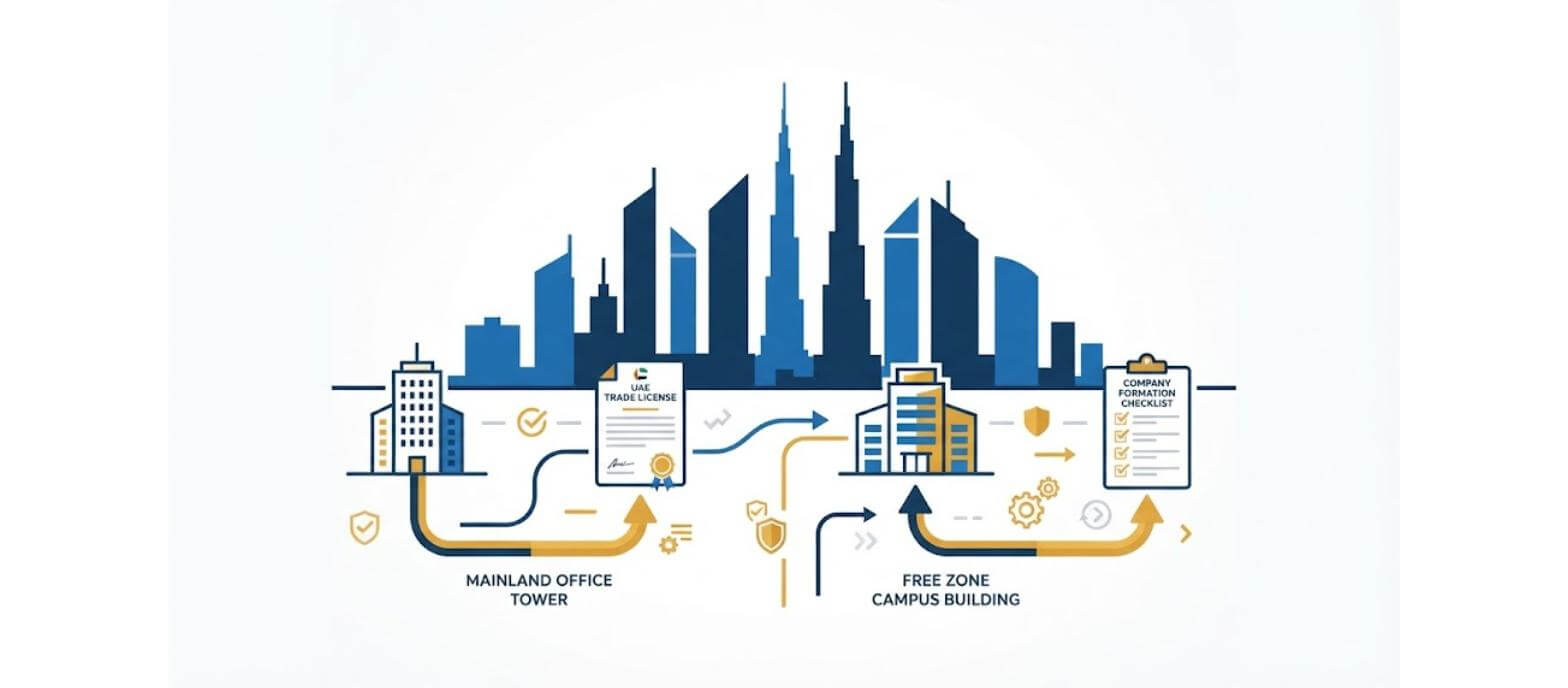
A Mainland company is licensed by the DED of the emirate it operates in and can trade with the local market and take on government contracts without restriction. A Free Zone company is licensed and regulated by its own free zone authority instead of a DED, and while it benefits from streamlined setup and, in most zones, full customs and tax advantages, it generally cannot sell directly into the UAE mainland market without either a dual license, a mainland branch, or a local distributor arrangement. Since regulatory reforms opened most sectors to full foreign ownership, 100% foreign ownership is now available in both structures, with a small number of strategic sectors — banking and defense among them — still restricted.
The two tracks also differ sharply in cost and timeline. A Free Zone company with no employee visas typically takes 1–3 working days to license, at a first-year cost in the region of AED 5,750–12,500; adding a single visa extends this to roughly 5–10 working days and AED 14,000–20,000. A Mainland LLC typically takes 2–4 weeks and costs in the region of AED 25,000–45,000 in its first year, though the government’s Bashr platform can process straightforward, fully compliant mainland applications in as little as 15 minutes once documentation is in order.
Registering Your Company: Trade Name, Initial Approval, and the MOA
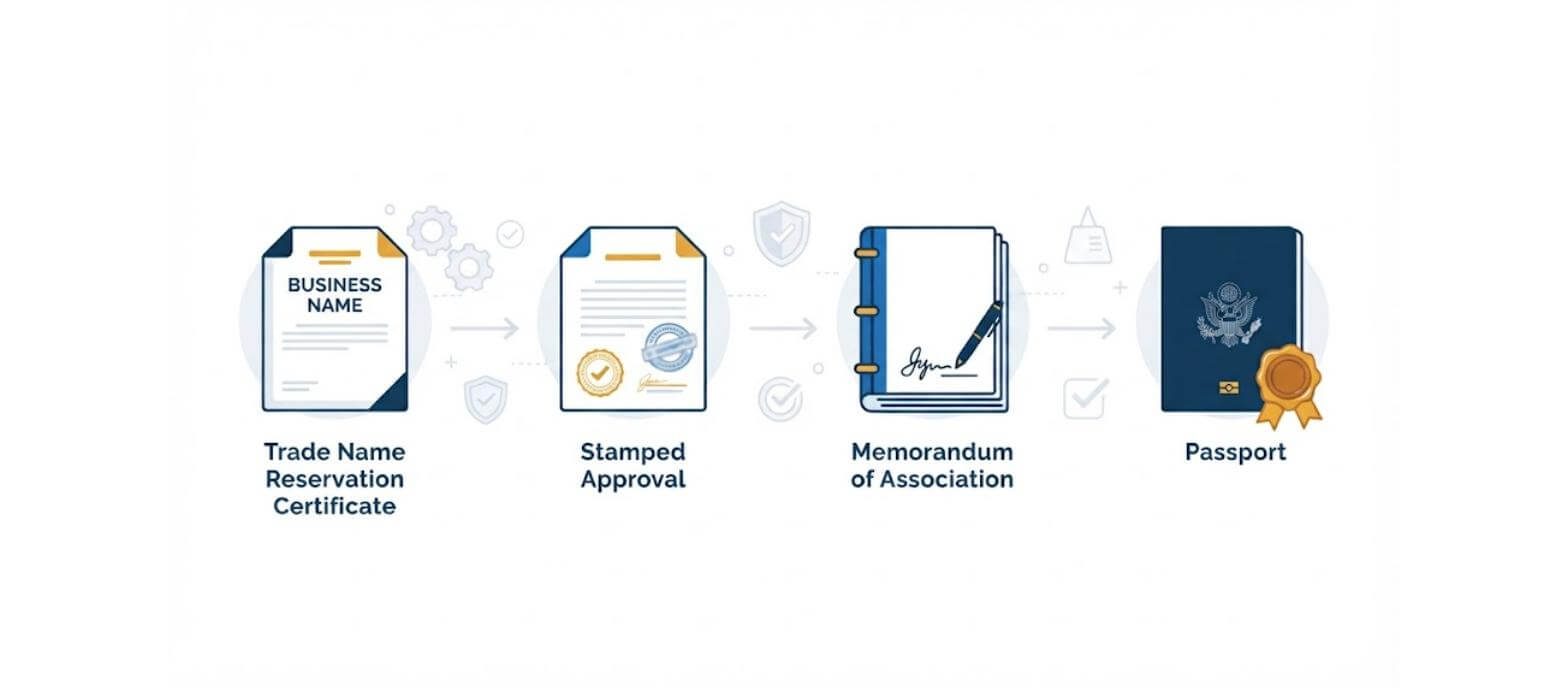
Regardless of which track is chosen, registration follows a broadly consistent sequence: reserve a trade name, obtain initial approval for the proposed activity, prepare the Memorandum and Articles of Association (MOA) along with shareholder identification documents, secure a registered business premises or, in many free zones, a flexi-desk arrangement, then submit the full application and pay the applicable fees to receive the trade license.
The step most often underestimated is document legalization for foreign corporate shareholders. Any overseas corporate document — a certificate of incorporation, a board resolution, a power of attorney — must go through a multi-step consular legalization chain: notarization in the home country, authentication by that country’s foreign affairs ministry, attestation by the UAE embassy there, and final verification by the UAE Ministry of Foreign Affairs. Skipping or mis-sequencing any one of these steps is one of the most common causes of registration delay.
The Ultimate Beneficial Owner (UBO) Register
Under Cabinet Resolution No. 58 of 2020, virtually all UAE-registered entities — mainland companies, free zone companies across every emirate, branches, and partnerships — must identify and register their Ultimate Beneficial Owners. Publicly listed companies and entities wholly owned by UAE government bodies are exempt.
A beneficial owner is any natural person who holds 25% or more of a company’s shares or voting rights, or who otherwise exercises control over its decisions — including indirect ownership traced through a chain of corporate shareholders, and control exercised through voting rights or the power to appoint directors rather than formal shareholding alone. If no individual meets the 25% threshold, the most senior managing official must instead be registered as a nominee.
New companies must register their UBOs within 60 days of trade license issuance. Any change in ownership or control must be reflected in the register within 15 business days, and UBO information must be reconfirmed at each annual trade license renewal. Non-registration or filing false or incomplete information carries a fine of up to AED 100,000 and can trigger a criminal referral; failing to update the register within the required window, or failing to maintain it properly, carries fines of up to AED 50,000 per instance.
Corporate Tax Registration and Filing
UAE Corporate Tax applies a 9% rate to taxable income above AED 375,000, with income at or below that threshold taxed at 0%. Free Zone entities can retain a 0% rate on their qualifying income as a Qualifying Free Zone Person (QFZP), but only if their non-qualifying income stays under a de minimis threshold — the lower of 5% of total revenue or AED 5 million. Breaching that threshold forfeits QFZP status, and the standard 9% rate then applies to all of that entity’s income for five consecutive years.
Every taxable person must register for Corporate Tax before filing; missing the registration deadline carries a fixed AED 10,000 administrative penalty, though a one-time waiver is available if the entity’s first tax return is filed within seven months of the end of its tax period. The return itself is due nine months after the end of the financial year — a calendar-year business closing its books on December 31 has until September 30 of the following year to file. Businesses whose revenue has not exceeded AED 3 million in any prior period can elect Small Business Relief directly on the Corporate Tax return, though this relief is currently scheduled to expire on December 31, 2026 unless extended.

UAE compliance rewards businesses that treat registration, UBO maintenance, and Corporate Tax as three separate but interlocking obligations rather than a single one-time setup task. A Free Zone license does not by itself grant mainland market access; a UBO register that was correct at incorporation can quickly become non-compliant after an unreported ownership change; and Corporate Tax status — including the valuable 0% Qualifying Free Zone Person rate — depends on an ongoing revenue mix test, not a one-time election.
Common UAE Company Registration and Compliance Mistakes
- Assuming a Free Zone license grants automatic mainland market access — in most cases a dual license, mainland branch, or local distributor is required to sell directly into the UAE mainland.
- Missing the 60-day UBO registration window after trade license issuance, or failing to update the register within 15 business days of an ownership or control change — both trigger fines regardless of intent.
- Believing Economic Substance Regulations still require a standalone annual notification or report — ESR filings were abolished for financial years ending after December 31, 2022; the relevant substance test is now assessed inside the Corporate Tax return for Free Zone Persons claiming the 0% rate.
- Registering for Corporate Tax late and incurring the AED 10,000 penalty — the one-time waiver only applies if the first return is filed within seven months of the tax period end, not the standard nine-month filing deadline.
- Treating Small Business Relief as automatic — it must be actively elected on the Corporate Tax return itself, is capped at AED 3 million in prior-period revenue, and is currently due to expire at the end of 2026 unless extended.
Registering a UAE Company or Staying Corporate Tax Compliant?
Need expert help with UAE company formation, UBO register maintenance, or Corporate Tax registration and filing? Contact our Corporate Compliance & Registration team today.